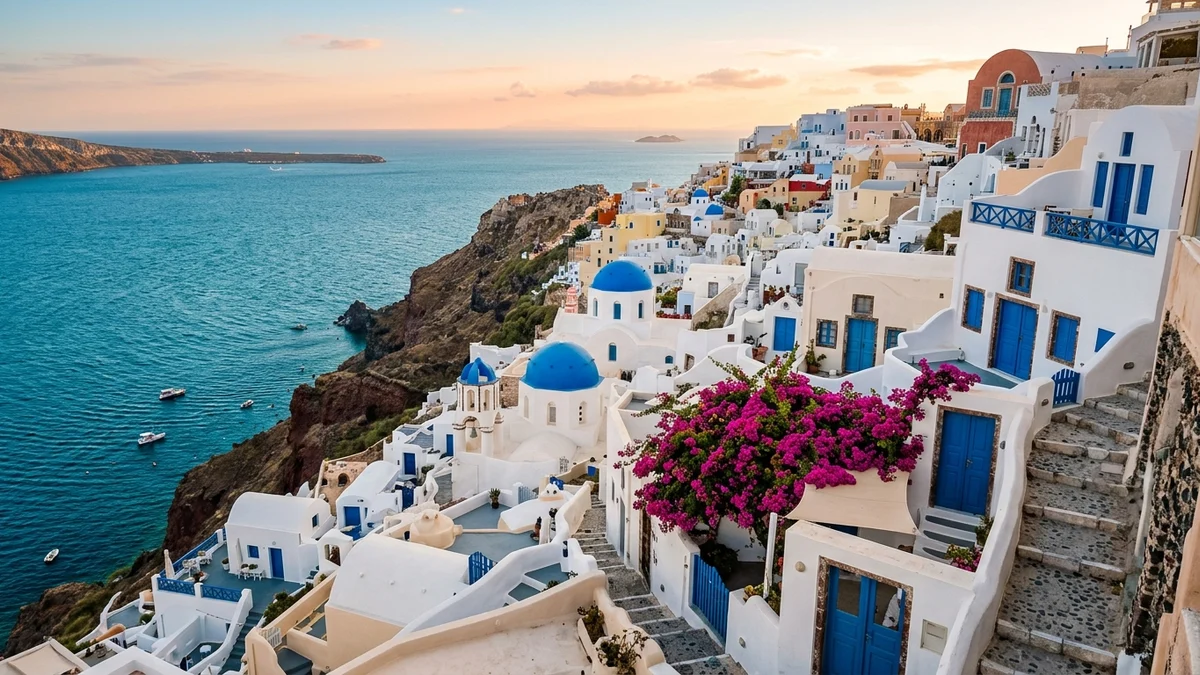
Few architectural landscapes on Earth are as instantly recognizable as the whitewashed villages with cobalt blue domes and doors perched over the cliffs of Santorini and Mykonos. Against the deep blue horizon of the Aegean Sea, this luminous panorama looks like an artistic masterpiece crafted purely for beauty. However, the origin of these iconic colors has little to do with modern design trends. The real story behind Greek island architecture is rooted in ingenious practical solutions by local islanders to endure blazing summer heat, sanitary responses against historic epidemics, and national laws that turned everyday resourcefulness into a global cultural symbol.
Dark Stone Villages and the Ancient Threat of Pirates
Contrary to widespread belief, the houses of the Cyclades islands were not always white. Throughout the Middle Ages and up until the early nineteenth century, islanders built their homes using dark volcanic stone quarried directly from the hillsides, leaving the exterior walls unpainted.
The primary reason was defensive camouflage. Viewed from the pirate galleys that roamed the Aegean Sea, the settlements blended naturally and fluidly into the rocky cliffs, appearing uninhabited from a distance. Streets were deliberately planned as narrow, winding labyrinths to disorient any raiders who managed to climb the hills.
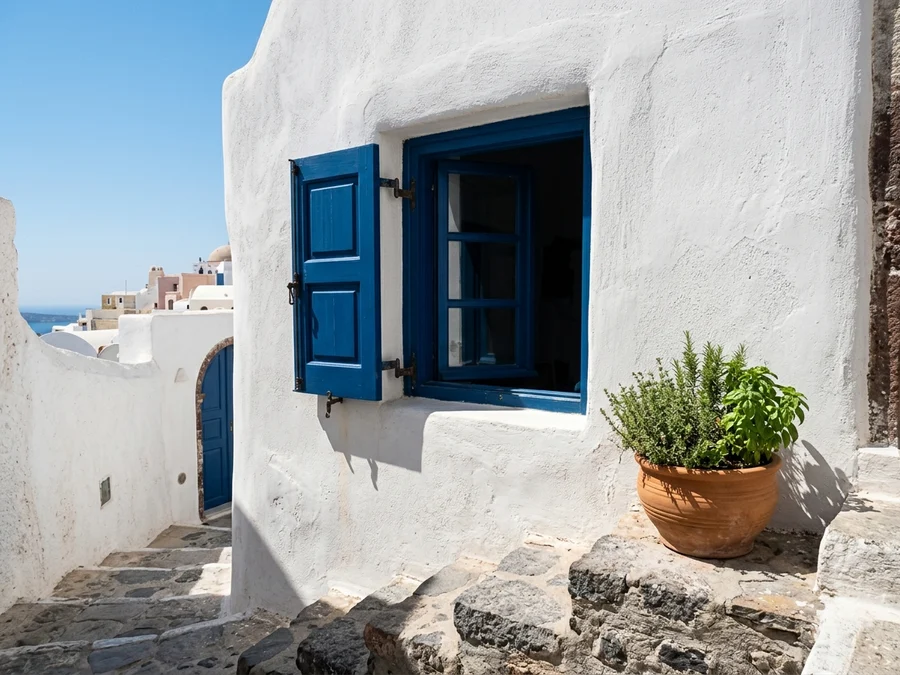
Organic texture and natural cooling: thick coats of mineral lime protect walls from scorching sun while shaping soft, handcrafted contours.
Mineral Lime Whitewash: A Thermal Shield and Natural Disinfectant
As maritime pirate raids declined in the nineteenth century, island communities turned their focus toward solving their greatest daily challenge: blistering summer heat, with temperatures regularly exceeding 95°F (35°C), alongside scarce fresh water and limited timber.
The answer came from an affordable, abundant natural resource: mineral lime. Brushed in continuous layers over porous stone masonry, whitewash served two indispensable functions:
Natural Solar Reflection: Bright white surfaces act as a thermal mirror, reflecting the vast majority of incoming solar rays and preventing volcanic stone from absorbing daytime heat. At night, indoor rooms remain remarkably cool and airy without mechanical air conditioning.
Sanitation and Home Hygiene: Lime possesses high natural alkalinity, serving as a potent natural disinfectant that prevents mold, mildew, and bacterial growth. In an era before modern plumbing, when households relied on rooftop rainwater collection, whitewashing roofs and walls ensured clean, safe drinking water for family cisterns.
This sanitary role became critical in 1938 during a national cholera outbreak in Greece. The government under Ioannis Metaxas issued an order requiring all island homes to be whitewashed with lime to contain the spread of disease, cementing the uniform white look across entire island villages.
The Secret of Loulaki Blue and the Law That Created the Postcard
While lime explains the pure white walls, where did the vivid blue on doors, window shutters, and chapel domes come from? The answer lies in the humble everyday routines of Greek fishermen and seafaring families.
Virtually every island household had access to a blue laundry compound called loulaki, an inexpensive bluing powder used for washing linens. Residents discovered that mixing a small pinch of loulaki into leftover liquid whitewash produced a rich, sun-resistant cobalt blue paint.
Islanders used this economical blue mixture to seal wooden doors against salty sea breezes and to highlight church domes and decorative arches.
The official standardization occurred in 1974. Following the period of military rule in Greece, a governmental decree mandated blue and white paint for all homes in the Cyclades. The policy honored the colors of the Greek national flag and established a cohesive, instantly recognizable aesthetic to promote Greece's emerging international tourism industry. The result was so successful that local communities embraced and preserved the tradition with great pride.
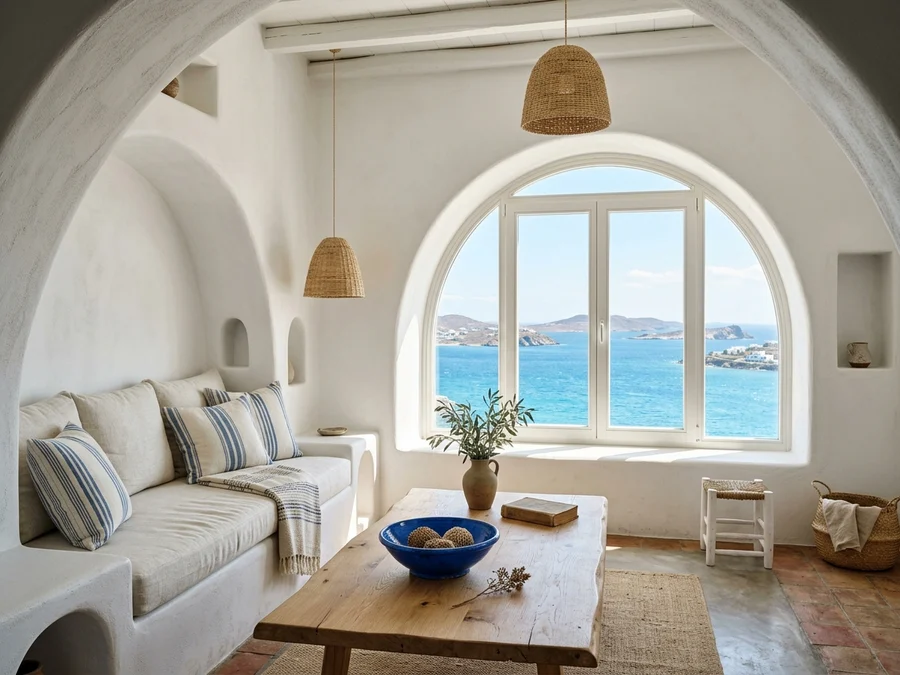
Serenity and light: Mediterranean interiors inspired by Greek architecture combine sculptural curved niches, airy textiles, and calm blue accents.
How Greek Island Style Inspires Contemporary Living
Today, Cycladic Mediterranean design is one of the most celebrated styles for coastal homes, sunny patios, and peaceful residential retreats. Built on timeless principles of simplicity and natural connection, this aesthetic centers on three core elements:
Soft Organic Lines: Rounded plaster corners, arched doorways, and built-in masonry benches replace rigid angles, fostering an inviting, handcrafted atmosphere.
Honest Materials and Natural Fibers: Crisp white walls pair effortlessly with unvarnished natural oak, light stone floors, breezy linen drapes, and woven rattan lamps.
Subtle Cobalt Accents: Rather than overpowering the room, deep blue appears in measured, elegant touches—a handcrafted ceramic bowl, indigo striped cushions, or an ocean-facing window frame.
Historical Summary: Colors in Greek Island Architecture
| Architectural Element | Material Origin | Primary Purpose |
|---|---|---|
| White Walls | Natural mineral lime plaster (whitewash) | Reflect scorching summer heat and sanitize against bacteria (1938 cholera mandate) |
| Blue Doors & Domes | Laundry bluing dye (Loulaki) mixed with lime | Low-cost wood protection against sea air and sacred architectural highlights |
| Original Dark Stone | Unpainted local volcanic rock (Middle Ages) | Camouflage cliffside villages against pirate raids in the Aegean Sea |
| Official Color Standard | Government decree in 1974 | Establish a unified global tourism brand and celebrate national flag colors |
Reimagining Your Space with Mediterranean Warmth
Bringing the breezy light and calm of Greek island architecture into your home does not require complex remodeling. Before picking up a paintbrush or ordering new furniture, you can explore how your living room, bedroom, or patio looks with whitewashed walls, arched niches, and blue accents using Arquitet IA.
Simply upload a photo of your space to test natural linen textures, light oak furniture, and stone finishes in seconds, helping you make design decisions with confidence and clarity.
Frequently Asked Questions
Were houses in Greece always painted blue and white?
No. Originally, homes on the Greek Cycladic islands were built from unpainted dark volcanic stone to camouflage coastal villages against pirate raids in the Aegean Sea. The blue and white palette became widespread throughout the 19th and 20th centuries due to cooling needs, sanitation mandates, and government laws.
How did lime whitewash protect homes from summer heat and disease?
White lime plaster reflects strong Mediterranean solar radiation, keeping indoor rooms naturally cool during hot summers. In addition, lime has high natural alkalinity that sanitizes surfaces and prevents bacteria. In 1938, during a cholera outbreak, the Greek government mandated nationwide whitewashing as a sanitation measure.
Where did the famous blue color on doors and domes originate?
The signature blue came from a laundry bluing powder called loulaki, an inexpensive cleaning product found in every island home. Fishermen and residents mixed tiny amounts of this blue dye into leftover whitewash to produce an economical, weather-resistant cobalt paint for doors, shutters, and chapel domes.
Is there a law requiring blue and white houses in the Greek islands?
Yes. In 1974, a government decree made the blue and white color scheme mandatory across the Cyclades islands to reflect national flag colors and foster a unified, globally recognizable tourism brand.
How can I apply Greek Mediterranean aesthetics to modern interior design?
Modern Cycladic Mediterranean decor focuses on soft organic curved walls, recessed plaster niches, light linen upholstery, unvarnished natural oak or driftwood, artisan ceramics, and understated touches of deep cobalt or navy blue in textiles and pottery.
📱 Visualize Mediterranean Interiors on Your Phone
Want to bring the breezy calm, warm light, and whitewashed serenity of Greek island homes into your living room, bedroom, or patio? Try Arquitet IA to preview room transformations instantly from a photo.
Try Arquitet IA Free