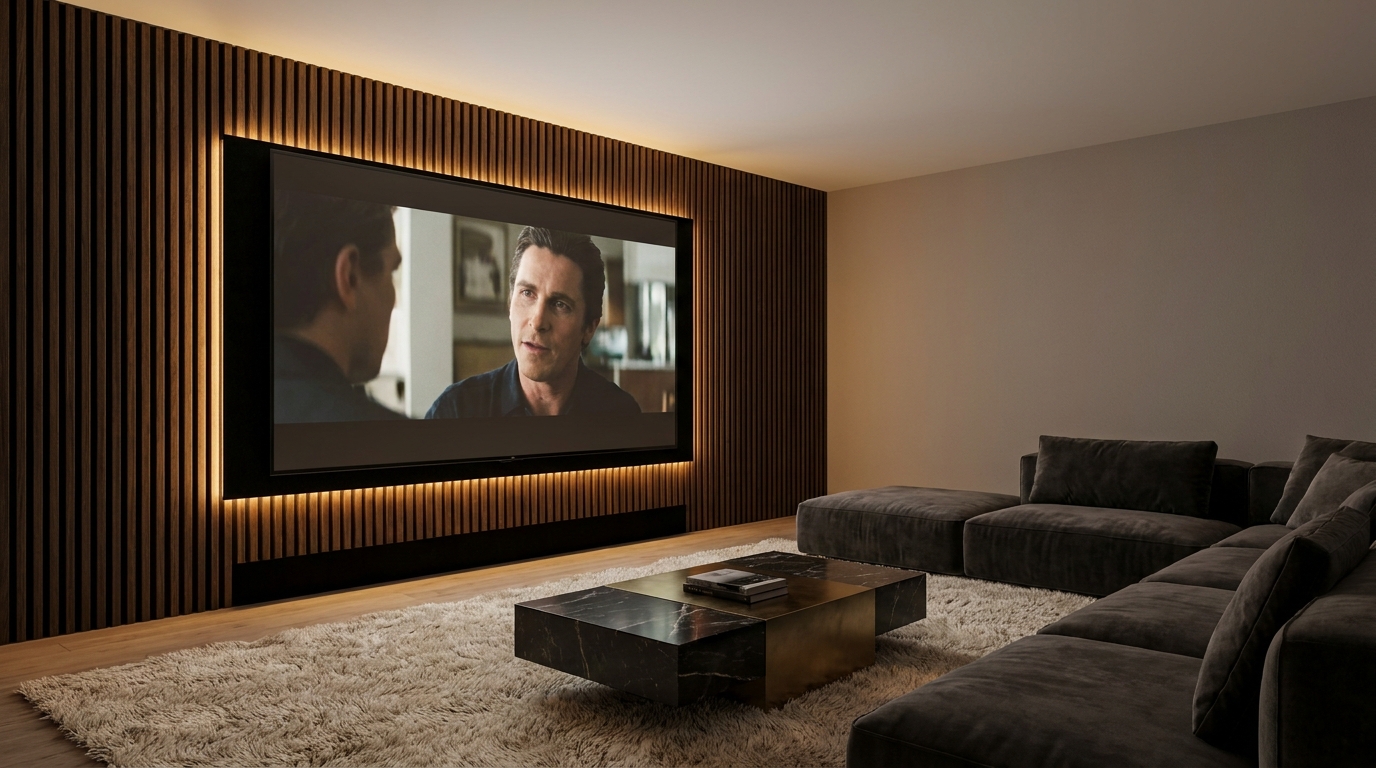
Residential screening rooms have reached a level of technological fidelity that matches—and frequently exceeds—commercial reference cinemas. However, prime contemporary architecture has decisively moved past the dark, bunker-like private cinemas of the 2000s, characterized by bulky leather recliners and obtrusive floor-standing speakers. Today's luxury mandate is seamless architectural integration: uniting studio-grade audio-visual performance within open, luminous living spaces without compromising interior elegance.
Achieving this standard requires an exacting synthesis of physics and aesthetics: from tuning room reverberation times through concealed quadratic acoustic diffusers to specifying ambient light rejecting (ALR) optical projection surfaces that deliver breathtaking 4K clarity under full daylight conditions.
Acoustic Physics: Balancing Sound Absorption and Quadratic Diffusion
The most prevalent failure in high-end media room design is over-investing in amplification while ignoring the room's boundary physics. Spaces dominated by hard reflective surfaces—such as polished marble slabs, expansive glazing, and smooth plaster—suffer from flutter echoes and modal room resonances, blurring orchestral soundtracks and making dialogue unintelligible.
Acoustical engineers target an optimal Reverberation Time (RT60) between 0.3 and 0.45 seconds for residential cinema. To achieve this clarity without creating an unpleasantly deadened acoustic environment, architects employ a balanced matrix of sound absorption (trapping harsh high frequencies) and quadratic diffusion (scattering sound waves uniformly in time and space).
Slatted Timber QRD Panels and Invisible Speaker Dispersal
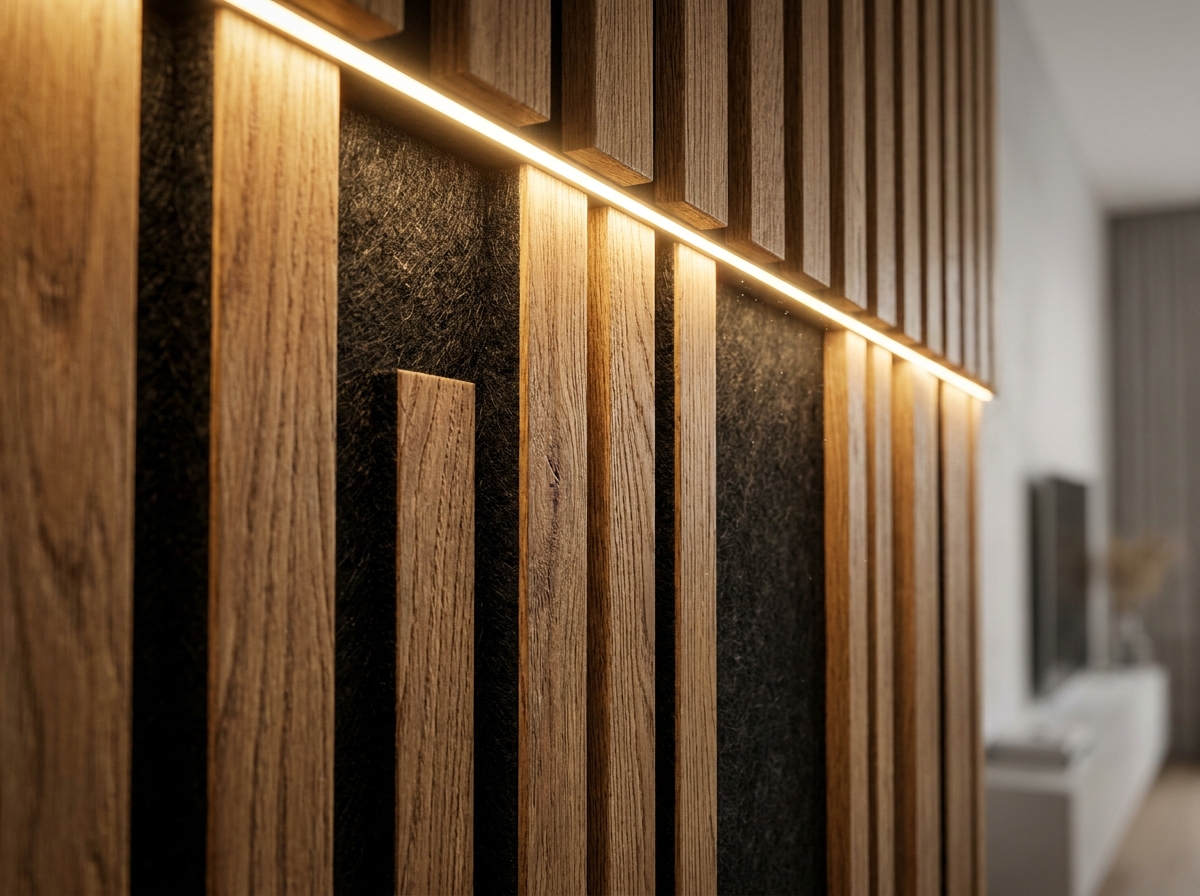
Fluted timber millwork has emerged as the premier architectural device for solving acoustic challenges with sculptural distinction. When engineered with mathematically varied slat widths and cavity depths (based on Quadratic Residue Diffusers, or QRD), solid American oak or walnut battens scatter specular sound reflections into diffuse, non-directional energy.
Behind the timber flutes, high-density recycled PET acoustic felt or dense mineral wool (with an NRC rating exceeding 0.85) absorbs acoustic excess while remaining completely invisible.
Furthermore, high-performance architectural audio effortlessly embeds inside wall and ceiling cavities. In-wall transducers concealed behind color-matched acoustic micro-mesh or skim-coated invisible drivers distribute sound with zero visual footprint. Concealed corner cabinetry integrates tuned bass traps that absorb standing low-frequency resonance, preventing structural rattle in adjacent glassware.
Ultra-Short Throw (UST) Laser Projection and ALR Optical Screens
The historical trade-off between massive flat-panel televisions and projection systems has been resolved by Ultra-Short Throw (UST) triple-laser projectors paired with Ambient Light Rejecting (ALR) optical screens.
Resting discreetly atop custom low-profile joinery just 20 to 30 centimeters from the wall, the triple-RGB laser projector casts a steep upward beam capable of rendering 100-inch to 150-inch 4K HDR imagery with complete coverage of the cinematic BT.2020 color gamut.
The ALR screen's microscopic lenticular optical surface directs projector light directly toward seated viewers while reflecting ambient ceiling and window glare away from the line of sight. The result is deep, OLED-rivaling black levels and vivid color saturation even in sunlit daytime salons.
Automated Scene Orchestration and Spatial Dolby Atmos
The immersion culminates in automated environmental scene orchestration. A single touch on an architectural interface initiates a seamless spatial transition: motorized motorized blackout draperies glide shut along hidden tracks, the laser engine awakens instantly, and general lighting fades into warm 2400K to 2700K indirect LED reveals beneath floating cabinetry and ceiling coves.
A calibrated Dolby Atmos 7.2.4 spatial sound system places acoustic objects three-dimensionally around and above listeners—with discrete height channels reproducing atmospheric rain or aircraft overhead, while dual DSP-equalized subwoofers deliver effortless sub-bass across deep modular seating.
Technical Specifications & Engineering Matrix for Luxury Home Theaters
| Subsystem | Engineering Specification | Performance Benchmark | Sensory & Architectural Benefit |
|---|---|---|---|
| Acoustic Conditioning | Fluted QRD timber diffusers backed by dense PET felt (NRC > 0.85) | Reverberation RT60: 0.3s to 0.45s | Pristine dialogue intelligibility and tight, uncolored bass |
| Laser Projection Engine | Ultra-Short Throw (UST) Triple RGB Laser 4K HDR Projector | Brightness > 3000 ANSI Lumens; 100% BT.2020 | Cinema-scale 100"–150" display without ceiling mounts or exposed cables |
| Optical Screen Matrix | Lenticular Ambient Light Rejecting (ALR) Fixed or Drop Screen | Ambient light rejection > 90%; 0.6–0.8 Gain | OLED-depth black levels and vivid contrast in daylight settings |
| Immersive Audio | Dolby Atmos 7.2.4 architectural in-wall/in-ceiling system with DSP | Linear 20 Hz to 20 kHz acoustic response | 360-degree holographic sound immersion with zero floor clutter |
Frequently Asked Questions on Home Cinema Design
What is the physical difference between acoustic absorption and sound diffusion in home theaters?
Absorption (achieved via dense PET felt or mineral wool) traps sound energy to reduce reverberation time and eliminate flutter echoes. Diffusion (provided by calculated quadratic residue slatted timber depths) scatters sound energy uniformly across the room without deadening the atmosphere, preserving vocal clarity and spatial airiness.
How does an ALR (Ambient Light Rejecting) screen outperform traditional white projector screens?
An ALR screen features an optical micro-lenticular surface that specifically reflects light originating from the ultra-short throw projector situated below it, while deflecting ambient overhead and lateral daylight. This preserves deep inky blacks and vivid cinematic contrast even with ambient room lights illuminated.
How can audio speakers be concealed without compromising Dolby Atmos soundstage precision?
Designers utilize architectural in-wall and in-ceiling transducers with paintable micro-perforated magnetic grilles, or entirely invisible speakers skim-coated beneath plaster. Behind slatted millwork, acoustically transparent fabrics conceal multi-channel drivers without attenuating mid and high frequencies.
How can homeowners preview custom home cinema millwork and screen layouts before building?
Using the Arquitet IA spatial AI application, users can photograph their living room and instantly render photorealistic 3D concepts with slatted timber feature walls, recessed screens, and atmospheric dimmable lighting.
Design Your Integrated Home Cinema with Arquitet IA
Discover how acoustic slatted timber paneling, concealed laser projection, and architectural mood lighting can transform your living room. Upload a photo in the Arquitet IA app to generate photorealistic 3D concepts in minutes.
Simulate Home Cinema Free →