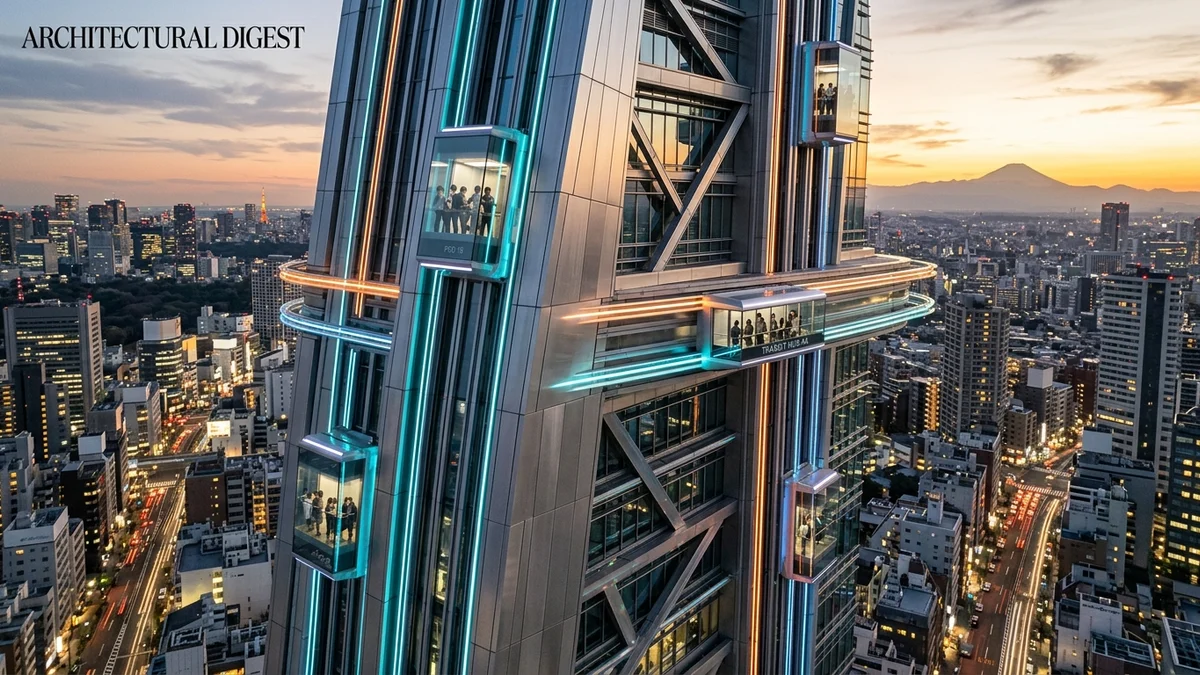
For over a century, the basic mechanics of skyscraper elevators remained largely unchanged: heavy cabins suspended by thick steel cables going up and down within dark central shafts. Today, a breakthrough in structural engineering promises to rewrite those rules. By replacing traditional cables with magnetic levitation motors similar to high-speed bullet trains, innovative projects are launching passenger pods directly onto the skyscraper's exterior skin, enabling them to travel both vertically and horizontally along the glass facade.
How Cableless Magnetic Elevators Work
The technology behind this leap relies on electromagnetism. Instead of top-mounted pulleys pulling heavy cables, active magnetic coils are embedded directly inside the tracks mounted on the building facade.
As electric currents pass through the rails, the glass pod levitates millimeters away without mechanical friction.
Switches at key junctions allow magnetic polarity to pivot instantly. This means a pod can rise to a specific floor, turn ninety degrees sideways, and glide horizontally toward another tower or building wing.
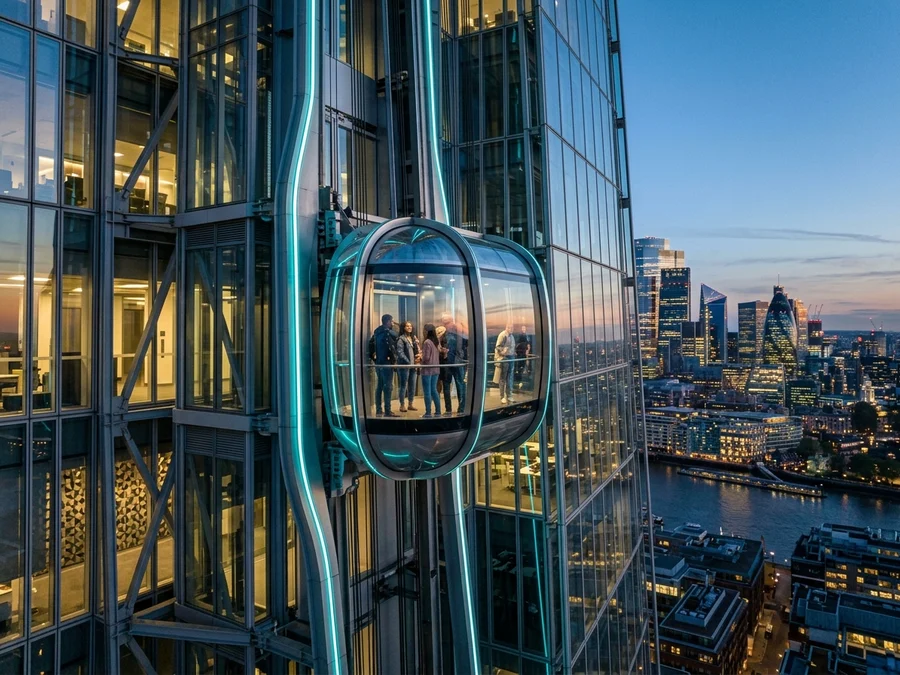
Frictionless motion: glass passenger pods float effortlessly along exterior magnetic rails.
Architectural Freedom and Space Efficiency
In traditional high-rise buildings, central elevator shafts consume up to forty percent of usable floor space on lower levels because each cable requires its own vertical chute.
Moving transit to the exterior skin and enabling continuous loop movement allows dozens of pods to share the same track system simultaneously.
This frees up vast interior areas for living and working while giving architects unprecedented freedom to design curved towers, skybridges, and bold open structures that were once structurally impossible.
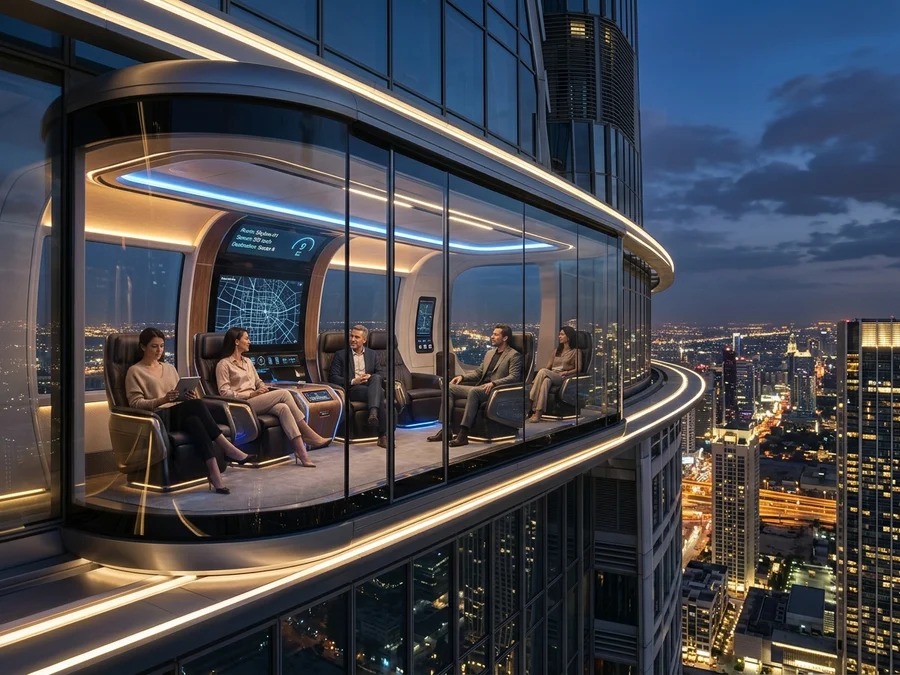
Unmatched view: riders enjoy panoramic city vistas while gliding horizontally along the facade.
Rider Experience and Advanced Safety
For passengers riding inside these transparent glass pods, the journey feels like floating weightlessly above the metropolis with spectacular panoramic views.
Without mechanical wheels or cable chatter, movement is whisper-quiet and silky smooth, eliminating the traditional bumps during acceleration and stopping.
Safety is built with multi-layered redundancy: in the event of a power outage, onboard battery reserves keep magnetic forces active until the pod safely arrives at the nearest station, supported by mechanical emergency clamps.
The Future of Urban Transit in Megacities
Engineers highlight that exterior facade transit will reshape daily life across sprawling urban complexes.
Rather than traveling down to the ground floor to walk to a neighboring tower, occupants can step into a maglev pod on their floor and ride directly across skybridges to adjacent buildings.
The building facade evolves from a static exterior wall into a vibrant, multi-directional circulatory system for high-density metropolitan living.
Visualize Futuristic Architecture with Arquitet IA
Curious to see how high-tech facades and illuminated exterior lines transform building designs? **Arquitet IA** lets you experiment with ideas instantly.
By taking a photo of any building or design sketch on your phone, you can simulate glass finishes, exterior lighting, and futuristic architectural lines directly on screen.
Frequently Asked Questions
How do cableless magnetic levitation elevators work?
Instead of steel cables and top pulleys, maglev elevators use linear motor technology built into exterior rails. Electromagnetic fields propel passenger pods smoothly without mechanical friction.
Are magnetic elevators on building exteriors safe in bad weather?
Yes. Systems feature triple magnetic braking, automatic mechanical emergency locks, and exterior guide rails engineered to withstand high wind loads and extreme temperature changes.
Why does horizontal elevator travel change skyscraper architecture?
Because pods can change directions naturally and fluidly, buildings can connect neighboring towers via skybridges without wasting floor space on massive central elevator shafts.
What are the main benefits for passengers and building occupants?
Wait times drop significantly because multiple pods travel on a continuous loop. In addition, riders enjoy breathtaking panoramic views of the city skyline.
How can I preview modern high-tech building designs with Arquitet IA?
With the Arquitet IA app, you can take a photo of any building or model to preview futuristic glass facades, exterior lighting, and architectural features on your phone.
📱 Explore Futuristic Architecture with AI
Want to experiment with high-tech facade designs and exterior lighting? Download Arquitet IA to simulate modern building concepts on your phone photo.
Try Arquitet IA Free