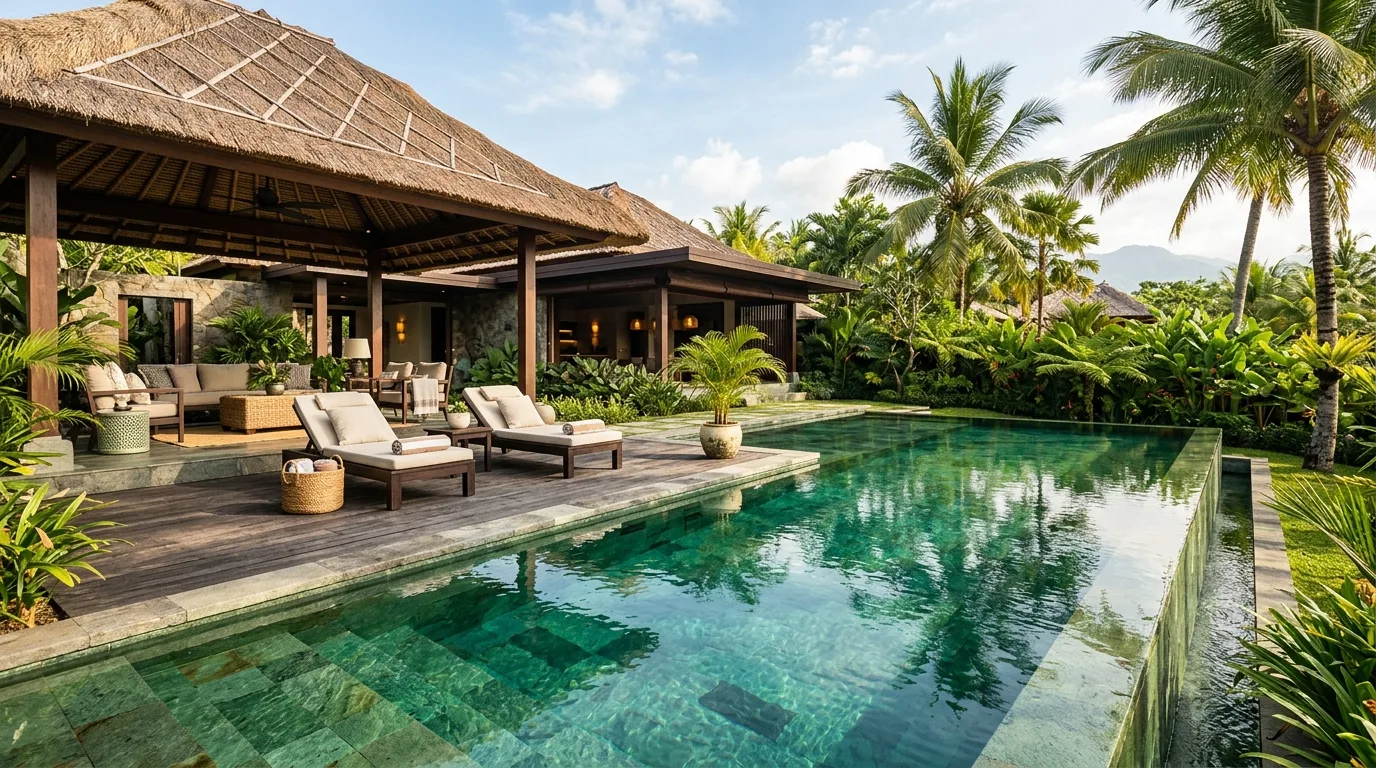
Luxury residential landscaping has undergone an extraordinary shift over the past decade. The ubiquitous turquoise glass mosaic pool tiles of previous eras have been superseded by authentic biophilic materials. Discerning architects and homeowners increasingly favor organic volcanic stones, river-tumbled pebbles, and honed natural travertines to sculpt private wellness oases that effortlessly merge with their surrounding botanical landscapes.
Beyond their indisputable visual appeal, natural stone surfaces deliver a rich, multi-sensory experience. Their tactile underfoot texture provides natural slip resistance, their thermal dissipation properties prevent overheating under midday sun, and their optical interaction with natural daylight transforms water features into living crystalline mirrors.
Hijau Stone and the Zeolite Mineral Advantage
Quarried from volcanic deposits across the Indonesian archipelago, Hijau Stone (internationally celebrated as *Green Bali*) stands as the benchmark material for high-end resort and residential swimming pools. In its dry state, the stone presents an understated, earthy green-grey hue. However, once submerged beneath water and exposed to direct solar radiation, it undergoes a striking optical metamorphosis, shifting into vibrant emerald, turquoise, and jade tones.
This distinct coloration is closely tied to natural zeolite compounds embedded within the volcanic matrix. Zeolites are microporous aluminosilicate minerals renowned for their natural ion-exchange capacity. They actively adsorb dissolved ammonia, micro-impurities, and heavy metals, providing a continuous biological filtration mechanism that keeps pool water pristine while reducing chemical disinfectant demands.
The Monolithic Drama of Black Lava Hitam Stone
For projects leaning toward contemporary minimalism, refined brutalism, or sculptural modernism, Hitam Stone (volcanic black lava basalt) provides an intense architectural presence. Featuring a dense, microporous structure, Hitam displays charcoal tones when dry and transitions into an opulent piano-black finish when wet.
Applied to infinity edges, cascading fountain walls, and expansive reflecting pools adjacent to open-plan living rooms, Hitam reflects the sky and surrounding foliage with mirror-like precision. Furthermore, the natural basalt absorbs ambient solar radiation during daylight hours, gently releasing stored warmth back into the pool water during cooler evening hours.
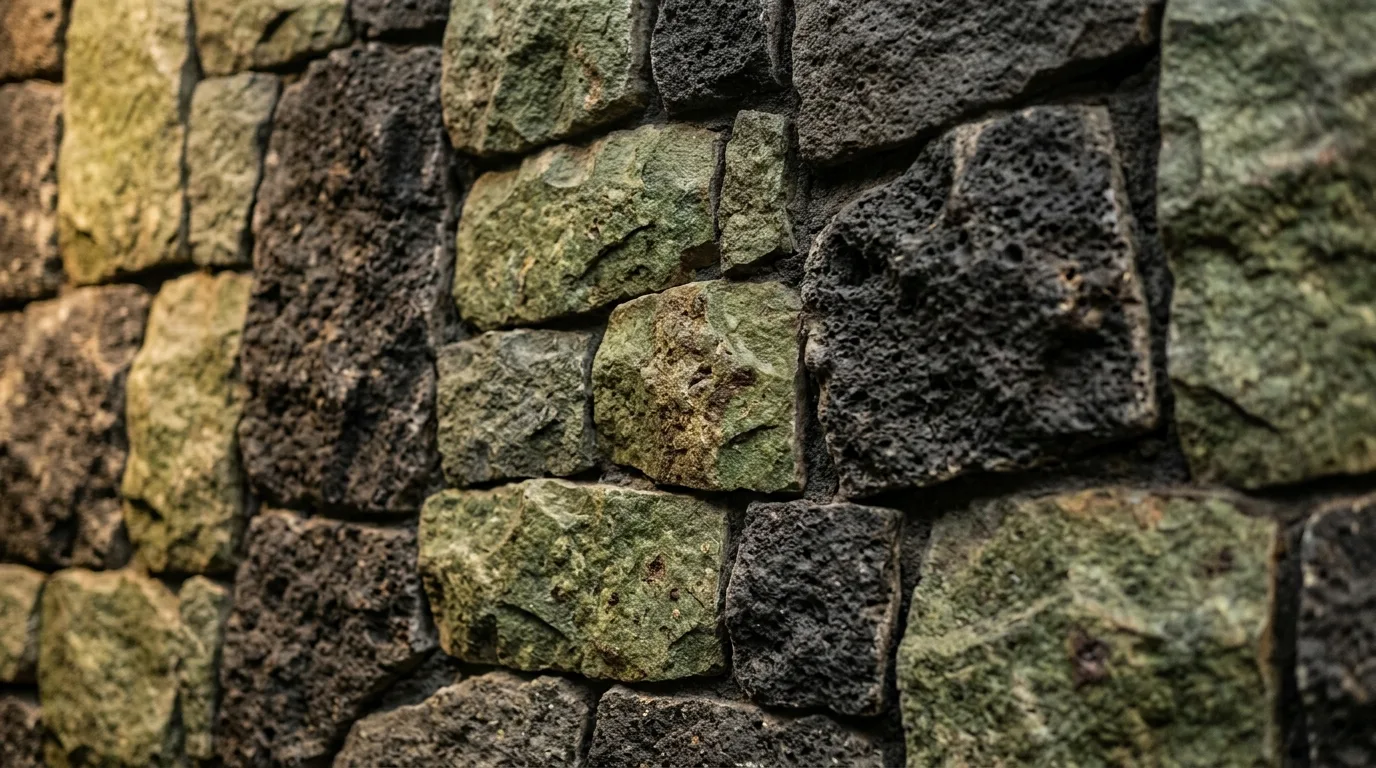
River Pebbles and Athermal Travertine in Spas & Sun Decks
The tactile journey extends naturally beyond the pool basin. Indonesian River Pebbles, smoothed over millenia by continuous fluvial erosion, are hand-sorted by diameter and color palette (pearl white, jade green, and charcoal). Embedded in sauna flooring, wet rooms, and reflexology pathways, these curved stones stimulate foot microcirculation and promote neuromuscular relaxation.
Simultaneously, Rustic Travertine Marble remains the premier choice for pool copings, submerged steps, and sun decks. Thanks to its porous calcareous structure and low thermal retention, travertine remains pleasantly cool under high ambient heat, eliminating the burning sensation common to manufactured ceramic pavers under the summer sun.
Installation Engineering, Waterproofing, and Maintenance
Achieving decades of flawless performance with natural volcanic stones requires uncompromising engineering standards. Because natural stone is inherently porous, the reinforced concrete basin must receive a heavy-duty, two-component polymer-modified waterproofing slurry, followed by a mandatory 72-hour hydrostatic leak test before tile application.
Submerged stone installation demands specialized high-performance thinset mortar (Type C2TES2/AC-III E). Installers must utilize the double-buttering method—troweling mortar onto both the concrete substrate and the back of each stone slab—to eliminate air voids that could otherwise lead to detachment under hydrostatic pressure.
For chemical water maintenance, pool specialists advise maintaining water pH strictly between 7.2 and 7.6 with total alkalinity at 80 to 120 ppm. Copper-based algaecides and harsh mineral acids must be strictly avoided, as cupric ions oxidize upon contact with volcanic stone pores, causing permanent discolored staining. Cleaning is best executed with soft-bristle nylon brushes and pH-neutral biodegradable cleansers.
Technical Specifications & Material Performance Matrix
| Material | Mineral Origin & Composition | Optical / Thermal Behavior | Recommended Application |
|---|---|---|---|
| Hijau Stone (Green Bali) | Volcanic rock enriched with natural zeolite (Indonesia) | Emerald to intense turquoise when wet; bio-filtering action | Pool interiors, plunge pools, water cascades |
| Hitam Stone (Black Lava) | Dense volcanic basalt rich in iron and magnesium | Deep mirror-black in water; moderate solar heat absorption | Minimalist pools, reflecting basins, architectural walls |
| Tumbled River Pebbles | Natural fluvial minerals shaped by hydraulic erosion | Silky smooth rounded surface; tactile foot massage stimulus | Spa floors, steam rooms, reflexology pathways |
| Rustic Travertine Marble | Porous natural limestone with preserved organic cavities | Superior athermal dissipation; non-slip under direct sunlight | Sun decks, pool copings, outdoor terraces |
Frequently Asked Questions on Natural Stone Finishes
What is the primary mineral difference between Hijau and Hitam volcanic stones?
Hijau stone (Green Bali) is a volcanic mineral rich in natural zeolites that turns into a vibrant emerald-turquoise shade when submerged in water under sunlight. Hitam stone is a dense volcanic basalt varying from charcoal grey to deep piano black, creating dramatic minimalist reflections in reflecting pools and modern swimming pools.
Does Hijau stone truly assist in swimming pool water purification?
Yes. Natural zeolites within Hijau's porous crystalline lattice possess cation-exchange capabilities, adsorbing organic compounds, heavy metals, and ammonia. This natural bio-filtration stabilizes water clarity and reduces chemical reliance over time.
What technical installation standards are required for submerged volcanic stone?
Submerged natural stone requires a two-component flexible waterproofing membrane with a mandatory 72-hour hydrostatic test, heavy-duty flexible polymer-modified thinset mortar (Type C2TES2/AC-III E) applied via double-buttering to prevent voids, tight-joint alignment, and neutral underwater polyurethane sealing at junctions.
How can designers and homeowners preview natural stone finishes before building?
Using the Arquitet IA spatial AI application, users can upload a photo of their patio, pool basin, or feature wall to generate photorealistic 3D renders, accurately simulating natural light refraction, water depth, and stone coloration.
Preview Natural Stone Finishes in Your Outdoor Space
Debating between the vibrant turquoise glow of Hijau Stone or the architectural drama of Black Lava Hitam? Upload a photo to the Arquitet IA app and generate photorealistic 3D spatial renders in seconds before breaking ground.
Simulate Natural Stones Free →