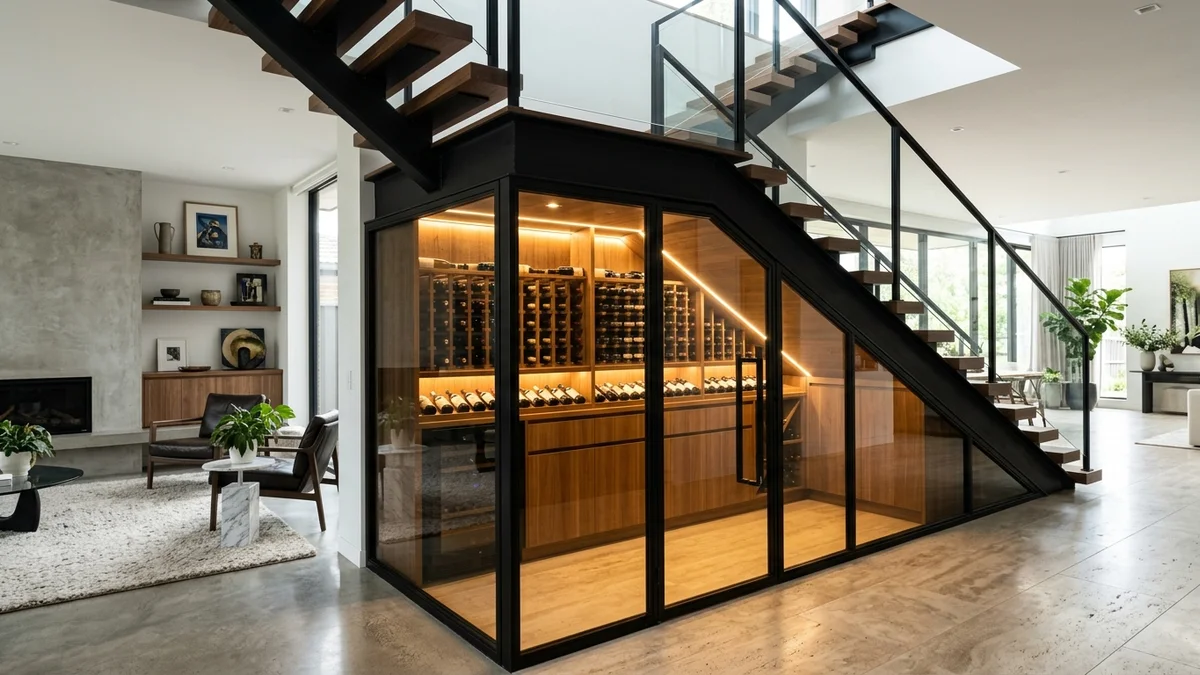
In luxury residential architecture, the triangular void beneath a main staircase has evolved from an overlooked storage closet into one of the most prestigious focal centerpieces of the home. Integrating a custom climate-controlled wine cellar within this perimeter marries spatial efficiency with serious enological connoisseurship. However, introducing a transparent, temperature-critical vault directly into an open living room requires rigorous thermodynamics, absolute hermetic sealing, and hygrometric control far beyond basic cabinetry.
Fine vintage wine is a living, evolving organic matrix. It reacts sensitively to thermal fluctuations, ultraviolet radiation, ambient vibrations, and cork desiccation. A truly successful under-stairs wine showcase is therefore an exercise in precision engineering concealed behind sculptural, museum-grade architectural craftsmanship.
Enological Physics: The Sacred Trinity of Temperature, Humidity, and Stillness
To allow collectible grands crus and vintage champagnes to age with complexity over decades, the cellar's internal atmosphere must faithfully replicate the microclimate of subterranean European stone vaults. Master sommeliers recommend a constant storage temperature between 14°C and 16°C (57°F to 61°F), allowing no more than a 1°C swing across seasonal cycles. Rapid temperature swings cause the liquid to expand and contract, pumping air through the cork matrix and prematurely oxidizing fragile aromas.
Equally vital is relative humidity (RH), strictly maintained between 65% and 75%. If humidity drops below 50%, natural cork dries out and shrinks, admitting oxygen into the bottle neck; conversely, humidity exceeding 80% fosters fungal mold that destroys priceless vintage labels.
Furthermore, residential staircases naturally transmit kinetic vibration from foot traffic above. Custom under-stairs cellars must incorporate industrial-grade neoprene vibration dampening pads and independent structural racking isolated from the stringers and risers, ensuring unbroken molecular sediment rest.
Split Climate Engineering and Vapor Barrier Architecture
Climate conditioning for a residential wine cellar cannot be achieved with standard domestic air conditioners. Conventional residential units dehumidify air aggressively (dropping ambient moisture below 40% RH) and cannot operate reliably below 18°C.
The industry standard is a dedicated split enological cooling system. A whisper-quiet evaporator coil equipped with indirect expansion fins and integrated ultrasonic humidification is concealed inside the ceiling millwork. The noisy compressor and condensing coil are ducted remotely to an exterior mechanical plant or ventilated utility room.
All peripheral framing, floor slabs, and sloped soffits under the stairs must be fitted with a continuous 6-mil polyethylene vapor barrier and closed-cell extruded polystyrene (XPS) or high-density spray polyurethane foam insulation (minimum 50 mm / R-15 value), clad in moisture-resistant greenboard drywall or natural stone veneer.
Hermetic Low-E Argon-Filled Glazing & Condensation Prevention
The crystal-clear glass facade that transforms the wine vault into a sculptural living room centerpiece is also its most vulnerable thermal boundary. Installing standard single-pane glass inevitably results in heavy external condensation—the dreaded "glass sweat" running onto hardwood living room floors due to the steep temperature gradient between the 14°C cellar interior and 24°C living ambient.
Eliminating condensation requires architectural double-glazed units: 6 mm tempered exterior glass, a 12 mm hermetic chamber filled with argon gas, and 6 mm interior laminated glass treated with a microscopic Low-E (low-emissivity) coating.
The Low-E coating reflects radiant room heat away from the cellar and blocks 99% of ambient ultraviolet wavelengths, while thermally broken steel or aluminum perimeter frames with aeronautical silicone perimeter seals guarantee zero air leakage.
Hardwood Millwork Curation and Cold LED Illumination
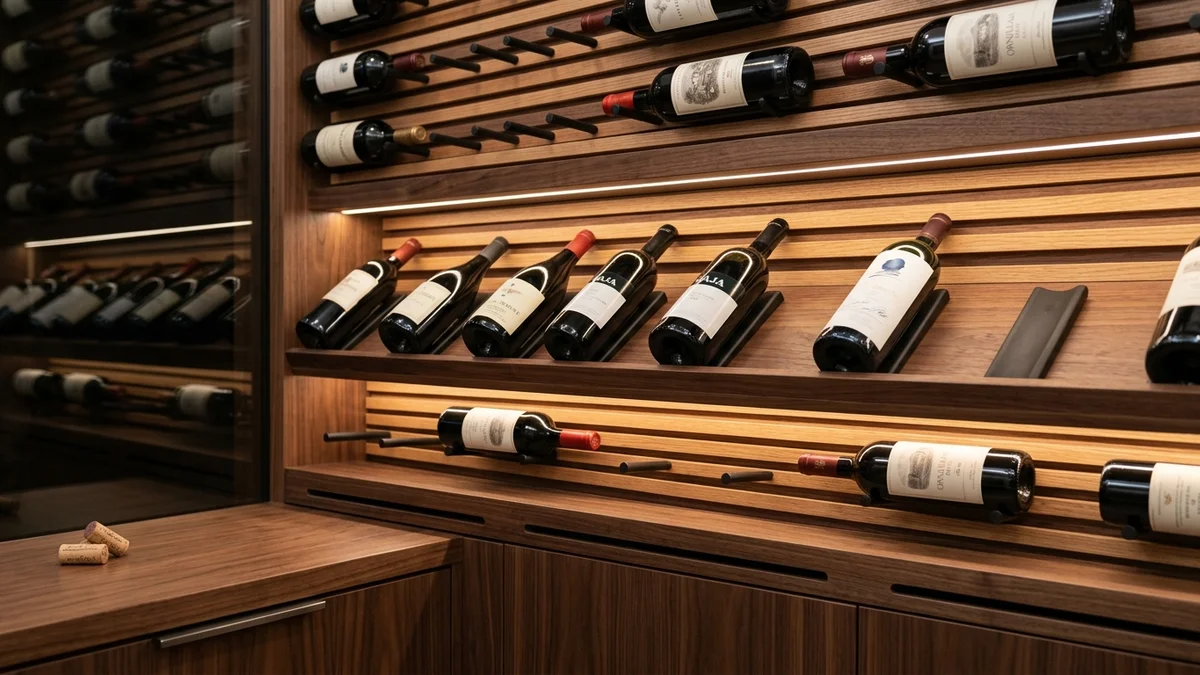
Inside the vault, timber selection for custom wine racks must combine structural stability with natural resistance to high ambient humidity. Premium hardwoods such as Brazilian Freijó, American Walnut, and Spanish Cedar are favored for their dimensional stability and absence of pungent aromatic resins that could permeate corks over time.
Display geometries effortlessly integrate individual 15-degree display cradles (keeping corks permanently bathed in wine while showcasing rare estate labels) with cantilevered matte-black anodized aluminum rods and smooth-sliding drawers for original wooden cases (OWC).
Illumination must be strictly specified with high color rendering (CRI > 95) linear LED fixtures tuned to an intimate 2700K color temperature. LED strips must emit zero infrared (heat) or ultraviolet light and are best automated via occupancy sensors or home automation scenes to ensure bottles remain in tranquil darkness until called upon.
Technical Specifications & Engineering Matrix for Luxury Wine Cellars
| Subsystem | Engineering Specification | Standard / Physical Parameter | Oenological & Structural Benefit |
|---|---|---|---|
| Thermal Control | Split enological climate system with remote condensing unit | 14°C to 16°C (57°F–61°F) ± 1°C stability | Preserves phenolic compounds; halts premature thermal oxidation |
| Humidity Regulation | Integrated ultrasonic moisture injection in airflow stream | 65% to 75% Relative Humidity (RH) | Maintains cork seal elasticity; prevents label mold formation |
| Glass & Framing | Double-glazed insulated unit (6mm + 12mm Argon + 6mm Low-E) | UV filtration > 99%; thermal U-value < 1.3 W/m²K | Eliminates glass condensation sweat; shields wine from light strike |
| Racking & Structure | Solid Walnut or Freijó on neoprene kinetic isolation mounts | Vibration transmission dampening | Ensures undisturbed sediment rest against staircase footfalls |
Frequently Asked Questions on Under-Stairs Wine Cellars
What is the optimal temperature and relative humidity for an under-stairs wine cellar?
The internal temperature should remain steadfastly between 14°C and 16°C (57°F to 61°F) for combined storage of reds, whites, and champagnes, with no more than 1°C of daily fluctuation. Relative humidity must be calibrated between 65% and 75% to preserve cork elasticity and prevent premature oxidation.
Why is argon-filled Low-E insulated glazing mandatory for glass wine cellars?
Standard single-pane glass experiences severe exterior condensation (sweating) caused by the sharp temperature differential between the cold cellar interior and the warm living room. Double-glazed units with argon gas chambers and Low-E coatings eliminate condensation and block 99% of harmful UV rays that degrade delicate tannins.
How should compressor heat dissipation and acoustics be engineered under a staircase?
The premier solution is a split refrigeration system: a silent evaporator coil is concealed within the cellar ceiling millwork, while the noisy compressor and condensing coil are ducted to a remote exterior or utility zone. Closed-loop vibration isolation mounts protect bottles from foot-traffic vibration on the stairs above.
How can homeowners preview custom under-stairs wine cellar millwork before construction?
Through the Arquitet IA spatial AI application, users can photograph the open under-stair cavity to instantly generate photorealistic 3D concepts with black steel framing, bespoke timber shelving, and atmospheric 2700K LED lighting.
Visualize Your Custom Wine Cellar with Arquitet IA
Envision how black steel framework, walnut cabinetry, and warm LED backlighting can transform your under-stairs space. Upload a photo to the Arquitet IA app to render magazine-quality 3D concepts before commissioning carpentry work.
Simulate Wine Cellar in App →