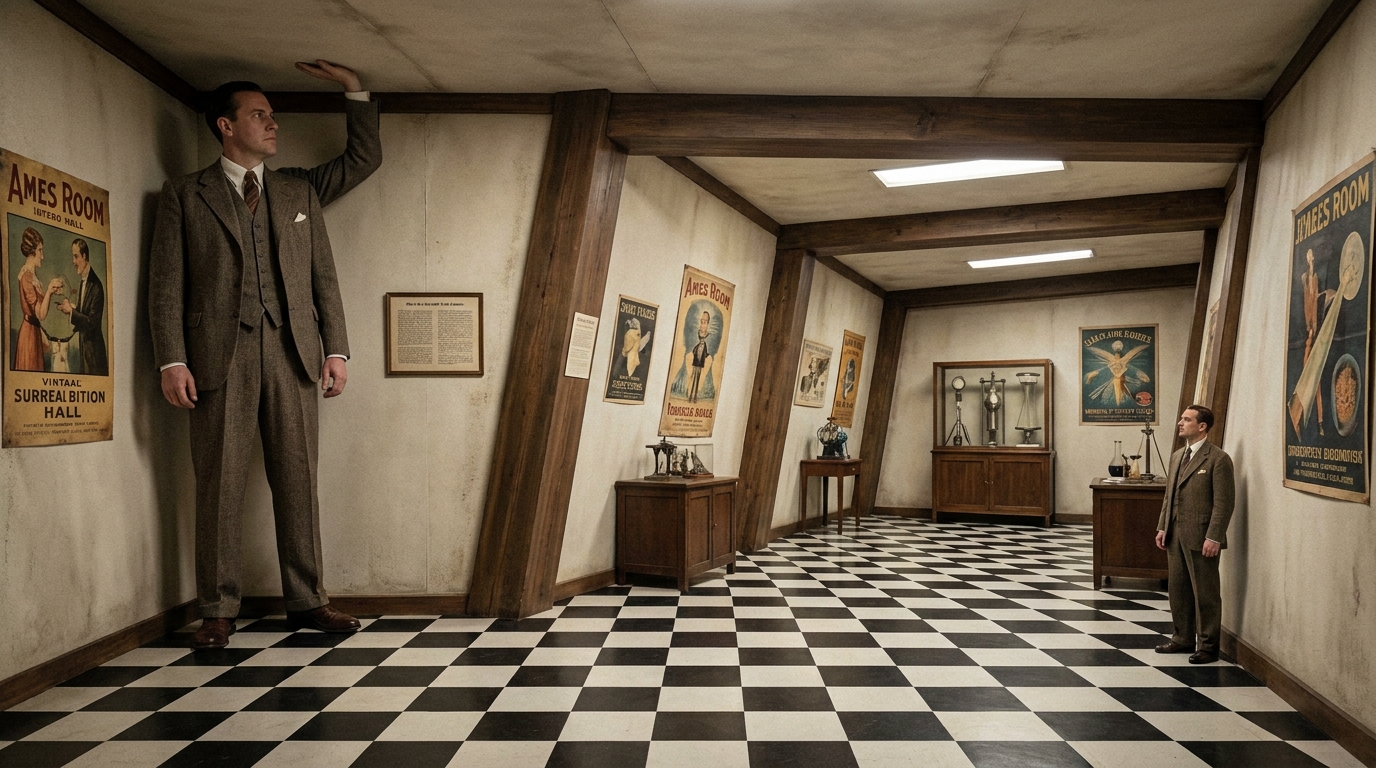
Few experiments in perceptual science demonstrate the constructed nature of human sight as vividly as the Ames Room. Conceived in 1934 by American ophthalmologist and psychologist Adelbert Ames Jr., this architectural installation reveals that the human brain readily distorts biological body sizes rather than accepting that an interior room could be utterly asymmetric and trapezoidal.
"The human visual system prefers to shrink or magnify living people rather than concede that an architectural enclosure is built without right angles." — Adelbert Ames Jr.
Trapezoidal Geometry & the Collapse of Euclidean Space
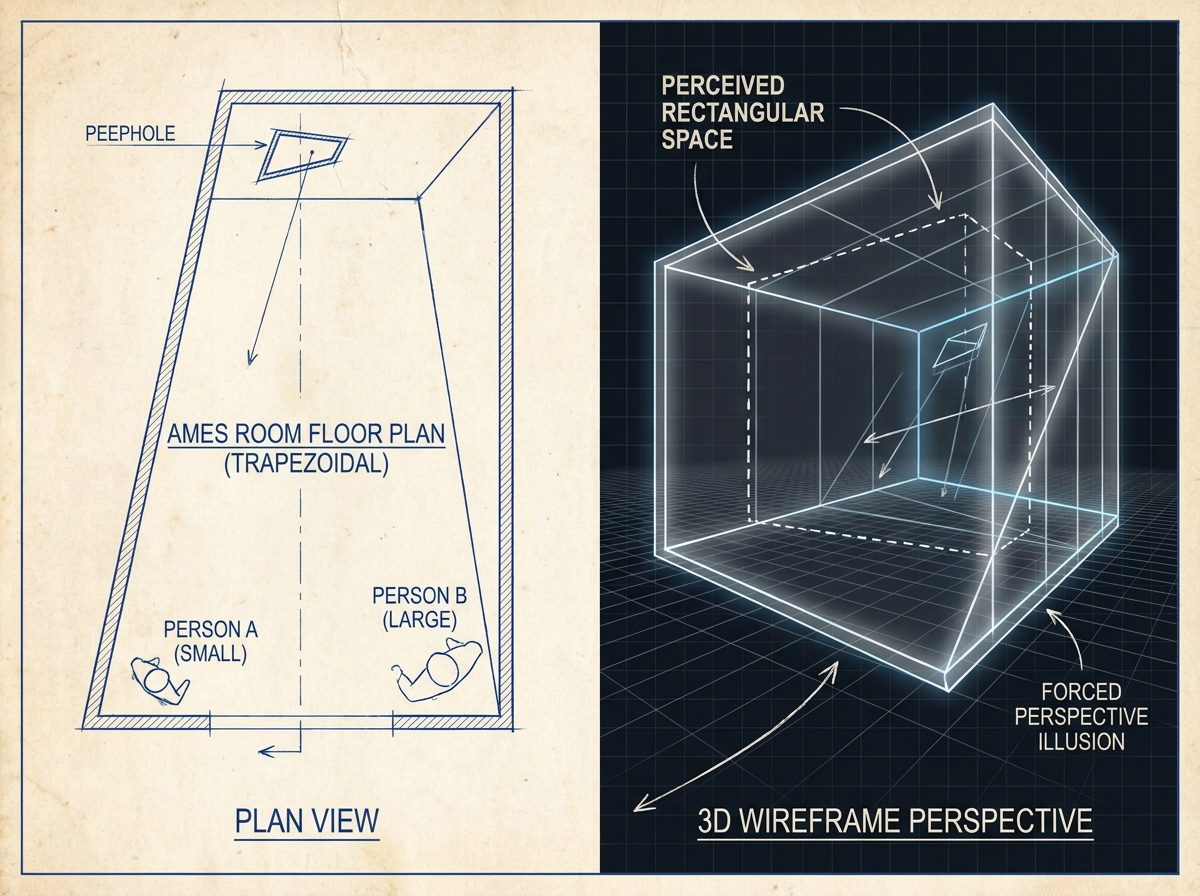
When viewed through a designated monocular peephole, the Ames Room casts the exact retinal projection of a standard rectangular cube. In physical reality, its footprint is an aggressive trapezoid.
The far-left corner sits substantially further back from the viewer than the right corner. Simultaneously, the ceiling slopes upwards toward the left while the floor slopes downward, doubling the true clear height on that side. The checkerboard floor pattern is mathematically skewed so that from the single viewpoint, it mimics an unwarped orthogonal grid.
Visual Cognition: Shape Constancy Over Human Scale
The underlying neurological driver is known as shape and size constancy. From early infancy, our neural pathways internalize that habitable rooms feature parallel walls, horizontal floors, and perpendicular 90-degree junctions.
When forced to evaluate contradictory sensory input inside the Ames Room, the brain prioritizes its deeply ingrained belief in orthogonal architecture over the physical scale of human occupants. As individuals traverse the floor, our visual cortex perceives them shrinking or ballooning in real time.
From Cinematic Staging to 'The Lord of the Rings': Practical Forced Perspective
The geometric mastery of forced perspective revolutionized cinematic set design long before the emergence of CGI and green-screen composites.
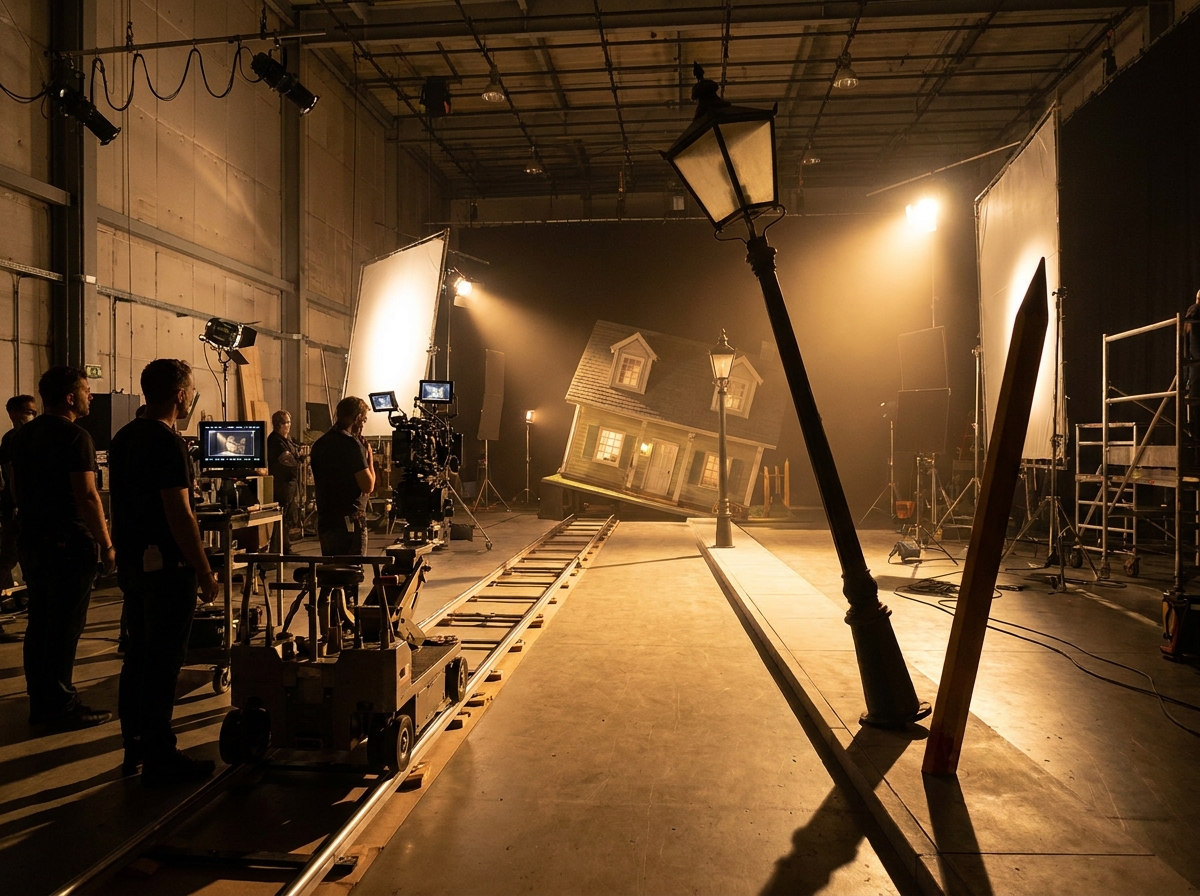
In Peter Jackson’s The Lord of the Rings trilogy, production designer Grant Major engineered trapezoidal dining tables and dual-scaled props grounded in Ames principles. This allowed Ian McKellen (Gandalf) to sit at the same table as Elijah Wood (Frodo) while appearing twice his size in camera without digital compositing.
Spatial Lessons for Interior Architecture
The Ames Room underscores that architectural space is fundamentally an interactive neurocognitive interface. In residential interiors, carefully aligned vanishing axes, slatted timber partitions, mirrored reflections, and wall-grazing fixtures enable designers to magnify the perceived volume of compact rooms without modifying structural masonry.
Explore related analyses in our studies on the Sheats-Goldstein Residence, the iconic Ennis House in Blade Runner, and practical techniques in Small Space Lighting Design.
Simulate Perspective & Spatial Illusions with AI
Curious how mirrors, fluted wood panels, and directional lighting can expand the perceived depth of your living room or hallway? Arquitet IA generates instant photorealistic 3D visual renders.
Try Simulator in Arquitet IAFrequently Asked Questions
What geometric principle creates the Ames Room optical illusion?
The room is constructed as a distorted trapezoid where the far left wall is positioned much further away from the observer, featuring an elevated ceiling and sunken floor. Seen through a fixed monocular peephole, the retinal projection matches that of a standard orthogonal room, compelling the brain to alter the apparent physical scale of occupants instead.
How did classic cinema make practical use of the Ames Room without digital CGI?
Master filmmakers such as Peter Jackson in 'The Lord of the Rings' built physical trapezoidal sets and distorted furniture props so that actors playing Hobbits appeared half the height of Gandalf within the exact same camera take.
What lesson does the Ames Room offer for contemporary residential interior design?
It demonstrates that perceived spatial volume is governed by vanishing lines, floor patterns, ceiling datum drops, and grazing light rather than raw square footage alone.