If you enjoy interior design, quirky history, or simply love fascinating anecdotes to share over a relaxing coffee, get ready for a wild ride. For centuries, European painters and high-society decorators paid lavish sums for small, pungent spheres of an exotic pigment known as Indian Yellow (or piuri). Its glowing, translucent warmth was unmatched by any known paint — yet its bizarre origin remained one of art history's best-kept secrets.
Just like our deep-dives into Mummy Brown paint crafted from actual mummies and the hazards of Victorian arsenic wallpapers, the historical pursuit of pure color was filled with strange chemistry.
The Bengal Enigma: Mango Leaves and Cattle Urine
Throughout the 1800s, crates of small, hard balls of raw piuri arrived in London and Paris smelling intensely of ammonia and sweet smoke.
In 1883, Indian civil servant T.N. Mukharji traveled to Monghyr in Bihar, India, and confirmed the rumors: a small community kept cows on a strict diet of fresh mango leaves and water. The leaves caused a metabolic imbalance producing concentrated euxanthic acid, turning the animals' urine a luminescent neon yellow. The liquid was collected in earthenware jars, boiled over open fires, rolled into balls by hand, and dried in the sun.
Capturing Sunlight on Canvas: From Turner to the Impressionists
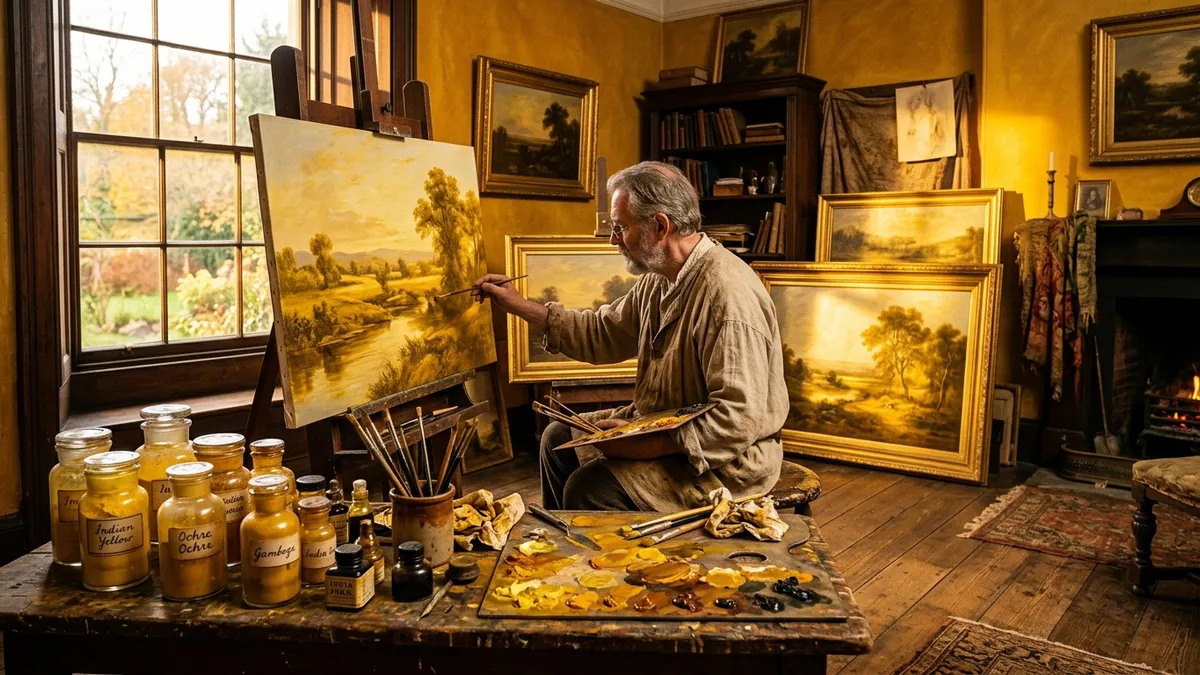
Despite its origins, master painters adored the pigment because it possessed extraordinary light transparency without muddying when layered.
Renowned landscape painter J.M.W. Turner relied heavily on Indian Yellow to produce his iconic glowing sunsets and atmospheric coastal skies. Alongside precious ultramarine blue ground from lapis lazuli, Indian Yellow was celebrated as the crowning gem of romantic art.
The Humane Prohibition and the Rise of Safe Synthetics
Because the mango-leaf diet caused severe malnutrition, Indian authorities legally banned the production of genuine piuri in the early 20th century under animal protection acts.
Modern chemists soon formulated synthetic alternatives using quinacridone and nickel azo complexes, capturing the brilliant warmth of Indian Yellow without any cruelty or toxicity.
Embracing Warm Golden & Earthy Tones in Modern Decor
In today's interior design, derivatives of golden yellow — such as velvet mustard, honey amber, and soft ochre — bring vitality and warmth into residential spaces.
As highlighted in our wall color and flooring simulator guide, warm yellows shine best when paired with raw linen textures, natural oak flooring, and gentle 2700K ambient illumination.
Overview: Curious Historical Pigments vs. Modern Equivalents
| Historical Name | Curious Historic Source | Modern Non-Toxic Equivalent | Contemporary Interior Role |
|---|---|---|---|
| Indian Yellow | Urine of cattle fed on mango leaves | Quinacridone & Mineral Oxides | Velvet mustard accents & warm textiles |
| Mummy Brown | Ground mummified remains & pitch | Synthetic Iron Oxide & Burnt Umber | Rich timber stains & textured microcement |
| Paris / Scheele's Green | Toxic copper arsenite in wallpapers | Water-based Sage Green acrylics | Calming biophilic bedrooms & living spaces |
| Ultramarine Blue | Crushed semi-precious Lapis Lazuli | Synthetic French Ultramarine | Accent front doors & velvet reading chairs |
Frequently Asked Questions
What was genuine historical Indian Yellow (Piuri)?
It was a brilliant, translucent golden pigment produced in the rural region of Monghyr, India, by dehydrating the urine of cattle fed exclusively on fresh mango leaves and water.
Why was the original production of Indian Yellow outlawed?
The strict diet of mango leaves severely malnourished the cattle. British colonial authorities criminalized the practice in the early 20th century under animal cruelty protection laws.
How are warm golden and mustard tones used in contemporary interior design?
Modern interior design uses safe ochres, amber, and velvet mustard on accent pillows, tactile wallpapers, and focal walls, harmonized with warm 2700K lighting and light oak floors.
How can I preview whether a warm yellow wall will suit my living room?
You can take a photo of your room in the Arquitet IA app to test warm golden hues, sand tones, and earthy palettes in 3D, seeing how natural daylight interacts with the shade.
Test Warm, Inviting Color Palettes in Your Home
Curious how warm mustard, rich terracotta, or soft neutrals look in your living room or bedroom? Snap a photo in the Arquitet IA app and preview custom color schemes with photorealistic 3D rendering in seconds.
Simulate Warm Colors on My Photo →