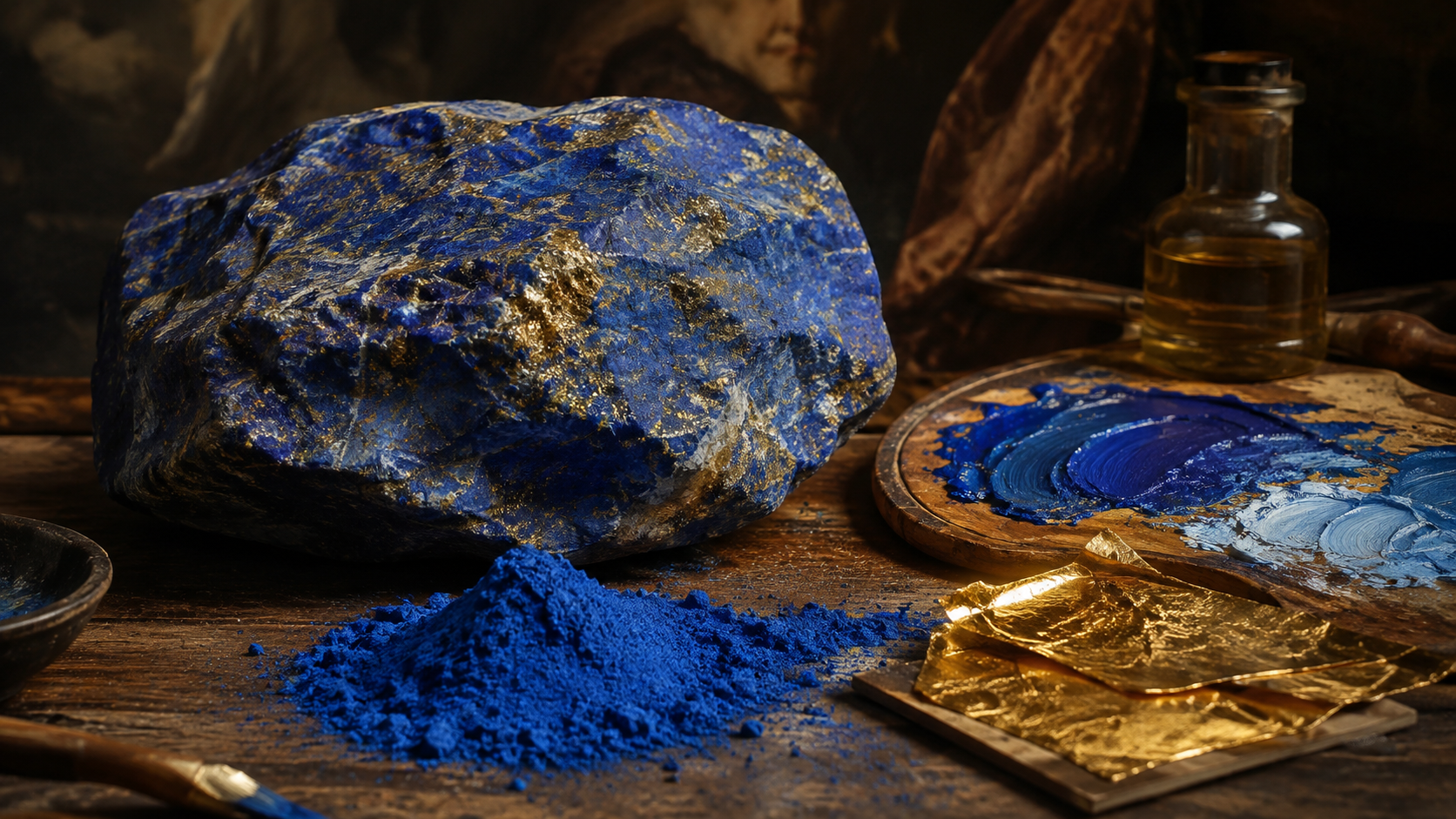
For centuries across European art history, deep blue was the ultimate currency of prestige. While ochres, burnt umbers, and reds were easily sourced from local clays and common minerals, a pure and unalterable celestial blue remained virtually unattainable. This was Natural Ultramarine Blue, derived from semi-precious lapis lazuli gemstones quarried above 13,000 feet in the mountains of Badakhshan, modern-day Afghanistan.
Perilous Silk Road caravan routes and an intricate medieval purification ritual ensured that every gram of this radiant mineral surpassed the open market price of pure bullion in Venice and Florence.
"Ultramarine is a noble colour, beautiful, and more perfect than any other colour. Nothing can be said of it that does not add to its glory." — Cennino Cennini, Florentine master in Il Libro dell'Arte.
From the Silk Road to Venice: The Origins of Ultramarine
The name ultramarine originates from medieval Latin ultramarinus, translating literally to "from beyond the sea." Throughout the Middle Ages and Renaissance, the only known deposit producing gem-quality lapis lazuli for paint was the legendary Sar-e-Sang mine in Afghanistan's rugged Badakhshan province.
Deep azure stones flecked with golden pyrite veins were hauled on pack mules across freezing Himalayan passes, crossing Persian deserts in merchant caravans before reaching Mediterranean ports. From there, Venetian galleys delivered the raw mineral to Italian workshops, where it arrived at breathtaking prices before processing even began.
Medieval Alchemy and the Extraction of Pure Lapis Lazuli
Simply grinding lapis lazuli into powder produces an underwhelming, chalky greyish-blue dust laden with calcite and pyrite impurities. Unlocking its true saturated hue required an elaborate alchemy method perfected in the 13th century:
The Purification Ritual of Natural Ultramarine
1. Fine Grinding: Raw lapis lazuli was pulverized into an ultra-fine mineral powder.
2. Resin Dough: The powder was kneaded into a warm mixture of beeswax, pine pitch, and mastic gum.
3. Lye Bath Extraction: The mass was gently kneaded under warm alkaline lye water over several days. Pure blue lazurite particles separated and settled at the bottom, while grey impurities stayed trapped in the wax.
4. Minute Yield: A full kilogram of premium lapis lazuli produced barely 20 to 30 grams of first-grade pigment.
The Virgin Mary's Robes and Renaissance Patronage Contracts
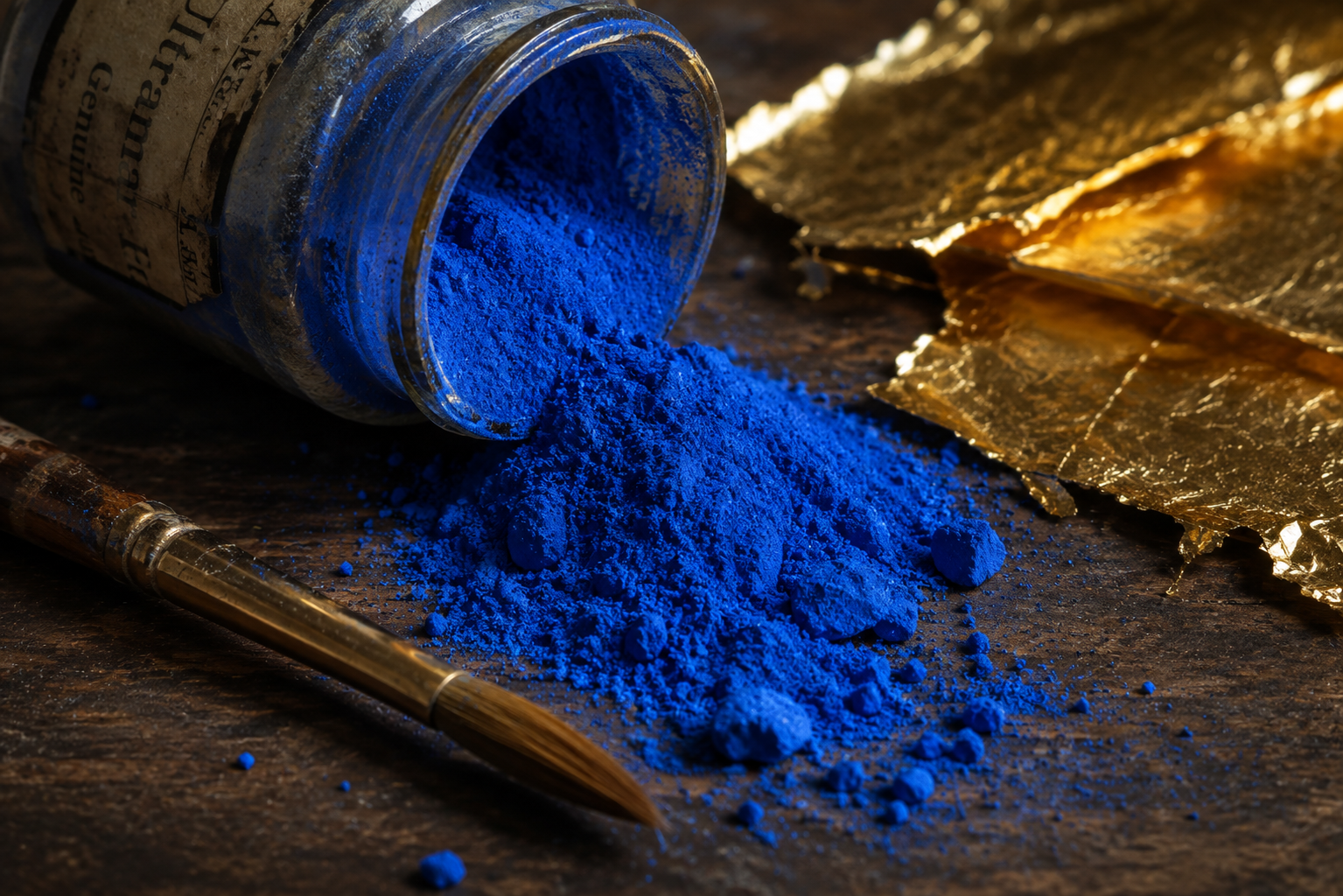
Due to its astronomical expense, using ultramarine was rarely left to an artist's personal discretion. In formal contracts between wealthy patrons (popes, kings, and dynasties like the Medici) and masters like Giotto, Fra Angelico, Michelangelo, and Titian, the exact quantity of ultramarine was specified by weight.
Patrons mandated that the prized pigment be reserved exclusively for the most sacred focal points: the mantle of the Virgin Mary or Christ's robes. Contracts explicitly forbade substituting cheaper copper azurite (which blackened over time) and required master artists to apply the precious blue with their own hands rather than delegating to apprentices.
Vermeer's Obsession and Financial Collapse
No historical painter pursued an affinity for ultramarine as uncompromisingly as Dutch master Johannes Vermeer (1632–1675).
While his contemporaries in Delft conserved the costly pigment for minor accents in commissioned portraits, Vermeer incorporated pure ultramarine into almost every canvas. He utilized it not only for focal attire — such as in Girl with a Pearl Earring and The Milkmaid — but subtly mixed it into background wall glazes, tablecloths, and shadows to capture natural daytime luminescence.
This relentless pursuit of material perfection burdened Vermeer with immense debts to pigment merchants, contributing to the severe financial collapse of his estate following his premature death.
The Chemical Race and Synthetic French Ultramarine (1828)
By the 19th century, dependence on Afghan mineral imports severely restricted industrial and artistic production. In 1824, France's Société d'Encouragement pour l'Industrie Nationale offered a 6,000-franc prize to anyone who could synthesize an affordable chemical equivalent.
In 1828, French industrial chemist Jean-Baptiste Guimet successfully formulated French Ultramarine by firing a kiln mixture of kaolin clay, sodium sulfate, charcoal, and sulfur. The breakthrough slashed the pigment's cost by more than 99%, bringing history's most noble shade to artists and decorators worldwide.
Ultramarine in Modern Architecture and Interior Design
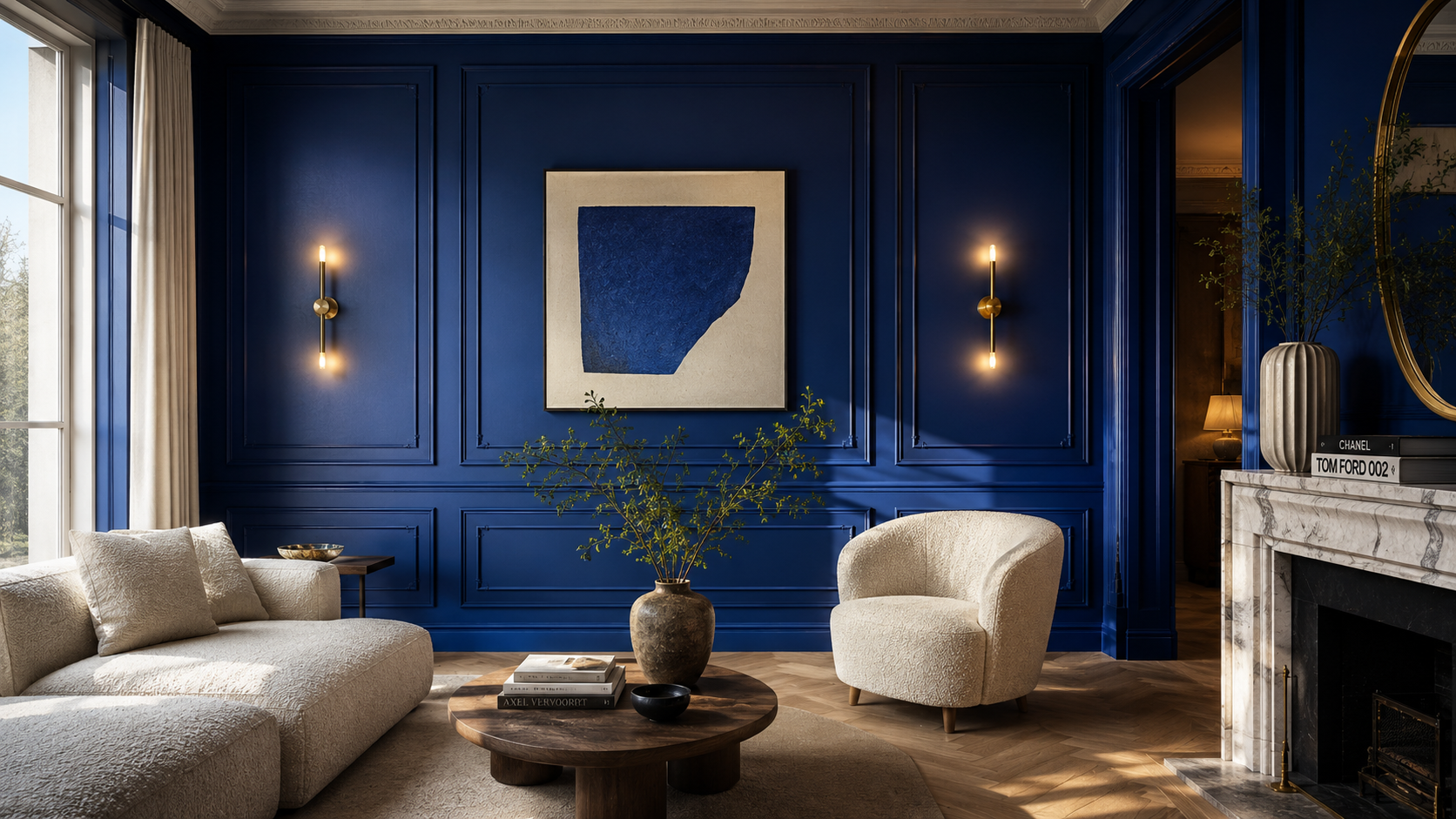
In contemporary interiors, ultramarine blue commands enduring elegance, depth, and spatial balance. Possessing subtle violet undertones that respond warmly to 2700K ambient illumination, it delivers powerful architectural accents:
- Statement Accent Walls: Creates striking depth in open living rooms, pairing harmoniously with walnut cabinetry and classical wall mouldings.
- Contrast with Warm Metals: The saturated blue provides an exquisite backdrop for brushed brass fixtures, matte gold hardware, and white natural quartzite slabs.
- Soothing Bedroom Ambiance: In private suites, soft variations of ultramarine lower visual tension and promote restorative sleep.
Historical Comparison of Rare and Famous Pigments
| Pigment | Source & Raw Material | Historical Status & Cost |
|---|---|---|
| Natural Ultramarine | Lapis Lazuli Gemstone (Badakhshan, Afghanistan) | More expensive than gold; reserved for sacred religious figures. |
| Indian Yellow | Urine of cows fed exclusively on mango leaves (India) | Highly valued; banned in the early 20th century on animal welfare grounds. |
| Scheele's Green | Copper Arsenite (Toxic Chemical Compound) | Popular in Victorian wallpapers until recognized as severely hazardous. |
| Mummy Brown | Ground Egyptian mummies and aromatic pitch | Heavily favored by Pre-Raphaelites until supplies naturally depleted. |
Simulate Historical Palettes and Textures with AI
Curious how ultramarine accent walls, natural woods, and ambient lighting look in your actual room? Arquitet IA generates photorealistic 3D interior proposals in seconds from a single photo.
Try Arquitet IA FreeFrequently Asked Questions About Ultramarine Blue
Why was natural ultramarine blue more expensive than pure gold?
Lapis lazuli rocks were mined exclusively in remote, high-altitude mines in Badakhshan, Afghanistan. After perilous overland caravan transport to Venice, a complex alchemy process involving beeswax and lye yielded only 20 to 30 grams of pure lazurite pigment per kilogram of raw stone.
Why was ultramarine strictly reserved for the Virgin Mary's robes?
Because of its exorbitant price and unmatched luminous permanence, patrons and church authorities mandated by legal contract that the pigment be applied exclusively to the most sacred central figure as a display of devotional piety and aristocratic prestige.
How did Johannes Vermeer suffer financial ruin from ultramarine?
Unlike his contemporaries who rationed the rare pigment for tiny highlights, Vermeer mixed pure ultramarine into background walls, shadows, and tablecloths across almost all his canvases, accumulating crippling debts with pigment merchants.
When was synthetic ultramarine blue invented?
In 1828, French industrial chemist Jean-Baptiste Guimet won a national prize by synthesizing 'French Ultramarine' through baking kaolin, sodium sulfate, charcoal, and sulfur, reducing the production cost by over 99%.