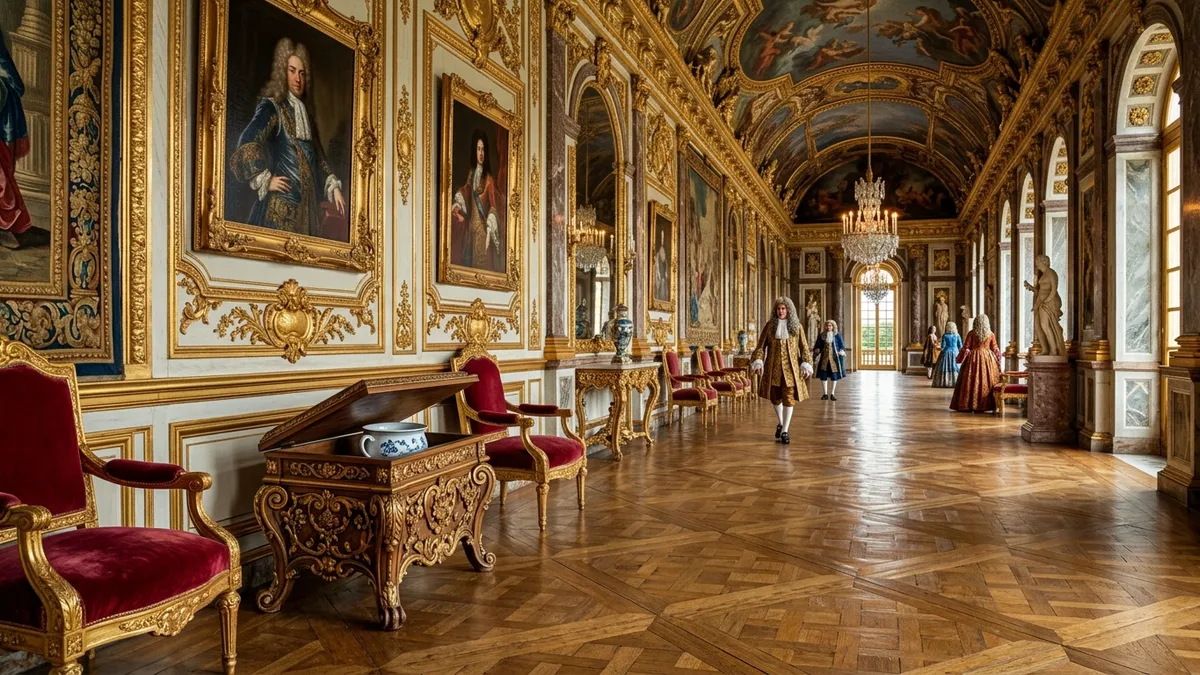
When wandering through the Hall of Mirrors at the Palace of Versailles or exploring grand 17th- and 18th-century European estates, the wealth of marble, gilded moldings, and frescoes conceals an astonishing historical reality: aristocratic architecture from the Baroque era omitted dedicated rooms for bathing and personal sanitation. The modern private bathroom simply did not exist.
At a time when medical doctrine viewed hot water baths as dangerous vectors for disease and hydraulic infrastructure was reserved almost exclusively for decorative garden fountains, European nobility relied on portable furniture, personal servants, and intricate court etiquette to navigate everyday hygiene.
Court Life at Versailles and Aristocratic Customs
Designed by Louis Le Vau and decorated by Charles Le Brun under Louis XIV, the Palace of Versailles was built as a grand political stage to house the French court. At its height, more than ten thousand courtiers, soldiers, and servants traversed its gilded corridors daily. Yet within hundreds of lavish suites, there was not a single plumbed bathroom connected to a sewer line.
To meet personal needs, nobles used the chaise percée (close-stool) — an upholstered armchair draped in velvet or brocade concealing a pewter or porcelain basin beneath a hinged lid. This piece was an instrument of prestige: kings frequently held formal audiences while seated upon it during the morning affaires du matin, with courtiers competing for the privilege of being present.
For everyday visitors and lower-ranking courtiers, the situation was far less refined. Lacking private quarters, individuals turned to staircases, secluded hallways, and palace gardens. Servants carried chamber pots across long galleries and emptied them into open pits or inner courtyards, creating a pervasive odor that heavy incense and scented oils struggled to suppress.
The Miasma Theory and the Era of Dry Hygiene
The omission of bathrooms in grand residences was not merely an engineering limitation; it reflected prevailing medical orthodoxy. Following the devastating plagues of the late Middle Ages, European doctors argued that hot water and steam opened the body’s pores, allowing lethal miasmas — toxic airborne vapors believed to cause illness — to invade vital organs.
As a result, immersion bathing was actively discouraged, often prescribed only in rare medicinal treatments. In its place, aristocracy developed what historians term toilette sèche or dry hygiene:
- Frequent changes of white linen: Nobles changed their fine linen undershirts multiple times per day to absorb body oils and perspiration. Immaculate white cuffs and collars served as the ultimate visual symbol of cleanliness.
- Friction with aromatic cloths: Dry or lightly scented cloths dampened with rosewater and floral vinegars were rubbed over the face, neck, and hands.
- Heavy reliance on rice powders and perfumes: Fragrant powders were generously applied to hair, wigs, and skin to absorb moisture and mask personal scents.
Historical Summary: Bathrooms in Palaces
17th & 18th Centuries: Total absence of indoor residential plumbing; reliance on close-stools and portable chamber pots.
Medical Thinking: Miasma theory cautioned against water immersion, making white linen changes and powdered perfumes the standard of purity.
Late 19th Century: Germ theory, urban sanitation infrastructure, and the birth of the modern tiled residential bathroom.
Dressing Tables and Early Porcelain Washbasins
As the 18th century unfolded, the Enlightenment brought renewed interest in comfort and bespoke furniture design. Specialized dressing tables and vanity cabinets began appearing in private boudoirs across France and England.
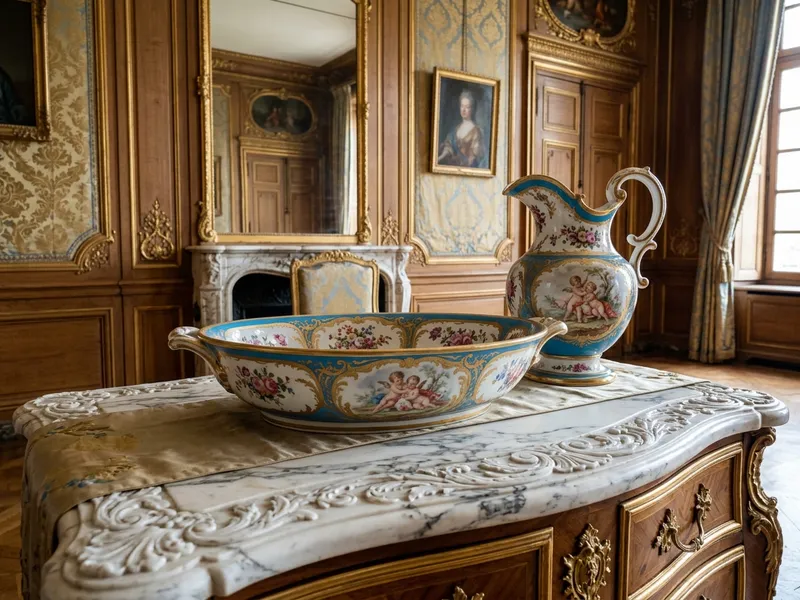
Finely crafted walnut and mahogany stands held hand-painted porcelain basins and water ewers produced by famed workshops such as Sèvres and Meissen. In 1730s France, the bidet also made its debut — an arched wooden stand holding a porcelain basin, tailored for personal washing after riding or long carriage travel.
Although visually refined, these stations still required household staff to haul hot water from distant kitchen fireplaces and carry away used water. Sanitation remained a portable routine within the bedroom rather than an independent architectural room.
The Arrival of Plumbing and the Modern Bathroom
The decisive shift occurred during the 19th century, driven by urban growth, industrial manufacturing, and bacteriological discoveries. When Louis Pasteur and Robert Koch demonstrated that diseases stemmed from microscopic pathogens in contaminated water rather than airborne miasmas, the hygienic landscape transformed permanently.
London and Paris constructed extensive underground water supply and sewer networks. Concurrently, the perfection of the S-trap flush toilet by engineers like Alexander Cummings and Thomas Crapper prevented sewer gases from entering living areas, enabling indoor water closets to be integrated directly into floor plans.
The bathroom transformed from an assortment of portable vessels into one of the most essential, refined spaces in the modern home — blending impermeable tiles, brass fixtures, and curated lighting for daily wellness.
Design Luxury Bathrooms and Master Suites with AI
Ready to upgrade your bathroom with premium stone textures, ambient lighting, and bespoke vanities? Take a photo of your existing space and generate photorealistic interior design concepts in seconds with Arquitet IA.
Try the Arquitet IA AppFrequently Asked Questions About Sanitation History
Where did royals and nobles relieve themselves at the Palace of Versailles?
The aristocracy used close-stools (chaises percées) in private antechambers or portable pewter and porcelain chamber pots carried by servants. During large court gatherings, stairwells, quiet hallways, and courtyard corners were frequently used due to the shortage of facilities.
Why did 17th-century physicians advise against full-body baths?
According to the prevailing miasma medical theory, warm water opened the skin pores, allowing toxic vapors and pestilence to penetrate the body. As a result, hygiene was largely dry, focused on changing clean white linen shirts and applying scented powders.
When did indoor plumbing and private bathrooms become common?
Modern residential bathrooms emerged in the mid-to-late 19th century, spurred by the Industrial Revolution, municipal sewage networks in Britain and France, and germ theory breakthroughs from Louis Pasteur and Robert Koch.
What was the 'dry hygiene' practiced by European courts?
Dry hygiene involved rubbing the body with dry cloths or linens dampened with floral vinegar, changing into fresh white linen clothes several times daily, and using rice powder and perfumes to absorb perspiration and mask odors.