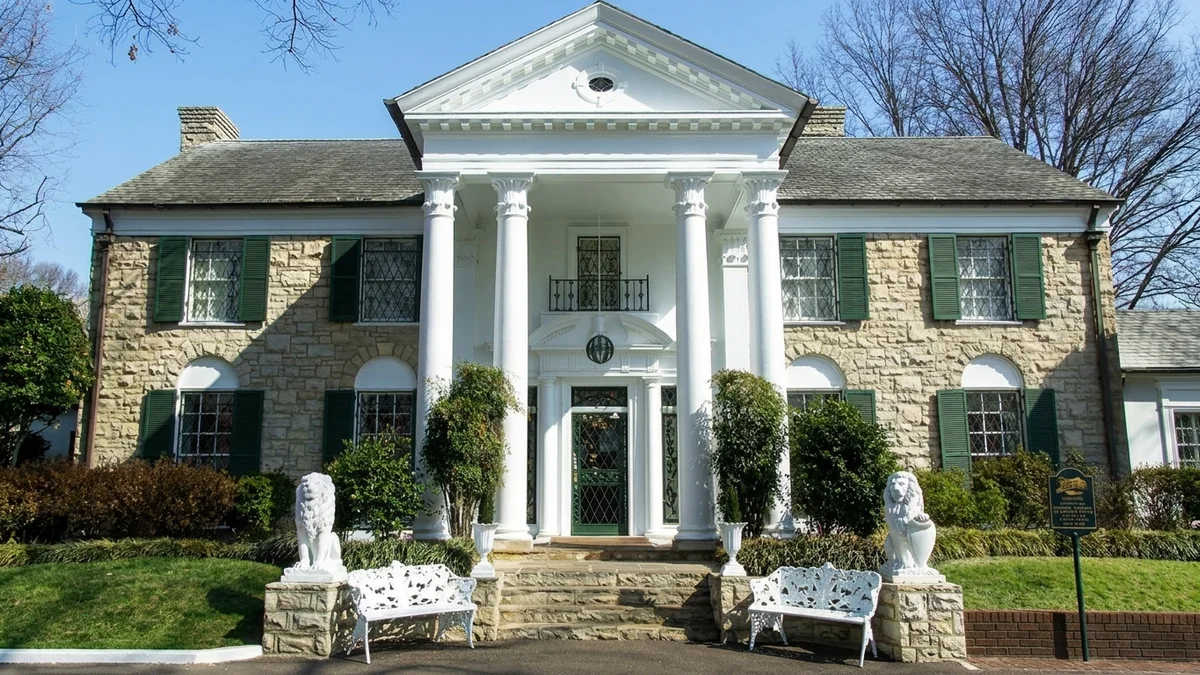
Few private residences encapsulate the personality, psychological sanctuary, and design evolution of a 20th-century cultural icon quite like Graceland. Located in Memphis, Tennessee, the 13.8-acre estate acquired by Elvis Presley in 1957 remains the second most-visited private home in the United States, surpassed only by the White House. Behind its dignified Colonial Revival facade with towering Corinthian columns lies a captivating labyrinth of 1970s custom interiors, experimental acoustic design, and a strictly sealed upper level that has sparked endless fascination for half a century.
"Graceland was never built to appease academic architectural critics; it was crafted as an impregnable fortress where a small-town boy could construct his own private universe." — Cultural Design Review.
The Neoclassical Facade and Historic 1957 Purchase
In March 1957, at just 22 years old and already an international cultural phenomenon, Elvis Presley paid $102,500 for the country estate originally built in 1939 by the Toof family. The residence showcased the timeless proportions of the Colonial Revival style with pronounced neoclassical influences, defined by light Mississippi Tishomingo limestone masonry, a classic triangular dentil-molded pediment, and four smooth Corinthian columns supporting the central entrance portico.
To safeguard his parents, Gladys and Vernon, from relentless crowds of admirers, the singer erected 6-foot stone retaining walls around the perimeter and commissioned the iconic custom wrought-iron gates featuring embedded musical scores and stylized guitar silhouettes crafted by local artisans.
The Formal Living Room and Handcrafted Peacock Stained Glass
Stepping past the front foyer, visitors encounter the estate's formal social wing: a light-filled living room effortlessly connected to the music room. The interior composition is anchored by a monumental 15-foot custom sofa upholstered in white damask fabric, designed specifically to trace the longitudinal wall without interrupting the flow of movement through the room.
The room's defining architectural signature is a pair of custom stained-glass panels installed in 1974 by Laukhuff Stained Glass. Executed in deep cobalt blue, warm amber, and emerald green, the stained-glass peacocks — an ancient symbol of immortality and majesty — frame the opening into the music room where Elvis's gold-leaf baby grand piano resides. Floor-to-ceiling bronze mirrored accent walls reflect daylight throughout the space, amplifying both warmth and visual depth.
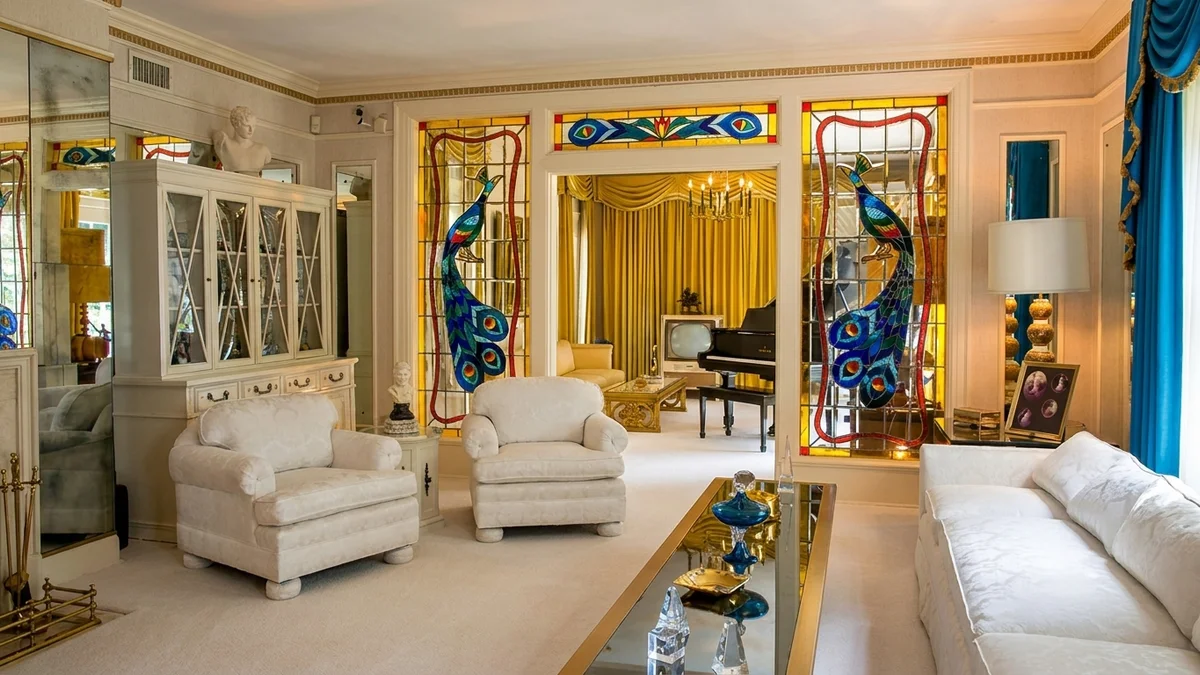
Formal living room: vibrant handcrafted peacock stained glass separating the parlor from the baby grand piano room.
The Jungle Room: Polynesian Scenography and Secret Recording Studio
Originally a screened-in rear porch, the legendary Jungle Room came to life in 1974, when Elvis purchased an entire showroom collection of Polynesian tiki furniture in less than half an hour. The space features heavily carved teak and rosewood armchairs with faux-fur upholstery, sculptural totems, and a full fieldstone masonry wall with a continuous recirculating waterfall that produced a temperate microclimate and a soothing natural soundscape.
Beyond its theatrical aesthetic, the thick green shag carpet installed across both the floor and the entire ceiling transformed the room's acoustic profile. By eliminating flutter echoes and reverberation, the space provided the acoustic dampening needed for RCA to park a mobile recording unit in the driveway in 1976. Inside this tropical cocoon, Elvis laid down the final studio tracks of his career, yielding the historic albums From Elvis Presley Boulevard and Moody Blue.
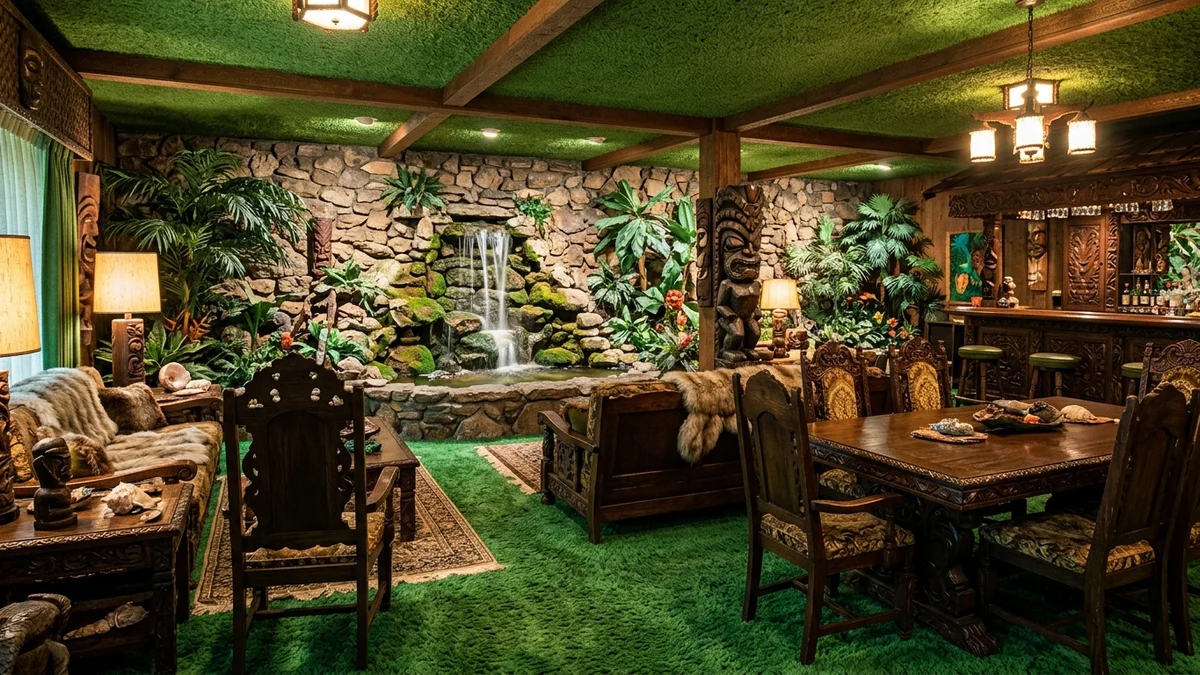
The Jungle Room: ceiling shag carpet for acoustic control, fieldstone waterfall, and 1970s Polynesian furnishings.
The 70s TV Room and Pleated Billiard Lounge
In the lower level of the mansion, 1970s pop-art experimentation reached its peak. The dedicated television lounge was styled in a bold contrast of royal blue and sunshine yellow with mirrored ceiling tiles, showcasing three televisions built side-by-side into custom millwork — an arrangement inspired by President Lyndon B. Johnson's habit of watching all three network news broadcasts simultaneously.
Directly adjacent, the billiard room showcases masterful artisanal upholstery: custom craftsmen spent weeks hand-pleating over 350 yards of floral cotton fabric across every wall and ceiling surface, creating a muffled, tent-like acoustic retreat designed for late-night games with friends.
The Unopened Sanctuary: Why the Second Floor Remains Sealed
While Graceland's ground level and gardens welcome over 600,000 guests every year, the sweeping main staircase remains blocked by a heavy velvet rope. The second floor has been sealed from all public access since Elvis's passing on August 16, 1977.
The private upstairs quarters served as Elvis's personal haven, featuring his master bedroom with blackout drapes tailored for daytime rest, a black-and-gold marble ensuite bath, his private office, and extensive dressing rooms holding his performance wardrobe. Preserved through the directives of Priscilla Presley and the late Lisa Marie Presley, the upper floor is kept under strict climate control and remains accessible only to the estate's chief archivist for routine conservation.
Architectural & Historical Matrix: Graceland Mansion
| Room / Feature | Design Style | Key Structural Element | Access Status |
|---|---|---|---|
| Main Facade | Colonial Revival / Neoclassical | Tishomingo limestone & Corinthian columns | Public (Official Tour) |
| Peacock Living Room | Hollywood Regency & Classic | Handcrafted leaded glass & 15-ft sofa | Public (Official Tour) |
| The Jungle Room | 1970s Polynesian Tiki Kitsch | Fieldstone waterfall & ceiling shag carpet | Public (Official Tour) |
| Basement TV & Pool Room | 1970s Pop Art & Psychedelic | 3 built-in TVs & 350 yds pleated fabric | Public (Official Tour) |
| Private Second Floor | Original Private Quarters | Untouched personal archive since 1977 | Strictly Forbidden |
Frequently Asked Questions
Why is the second floor of Graceland forbidden to visitors?
The second floor housed Elvis Presley's master bedroom, bathroom, and private office, serving as his strictly secluded personal refuge. Following his death in August 1977, the Presley family mandated that the upstairs remain private and preserved in its exact historical state, shielded from public tours.
What makes the Jungle Room historically significant in music recording?
The Jungle Room combined carved Polynesian furnishings, an interior stone waterfall, and thick green shag carpet extending across both floor and ceiling. The acoustic dampening provided by the ceiling carpet turned the room into a functional recording studio in 1976, where Elvis recorded his final studio albums, 'From Elvis Presley Boulevard' and 'Moody Blue'.
When did Elvis Presley purchase Graceland, and what architectural style is it?
Elvis purchased Graceland in March 1957 at age 22 for $102,500. The mansion is designed in the Colonial Revival / Neoclassical style, featuring Mississippi Tishomingo limestone masonry and four prominent Corinthian columns with a triangular pediment.
Where is Elvis Presley buried at Graceland?
Elvis is buried in the Meditation Garden on the estate grounds, alongside his parents Gladys and Vernon, his grandmother Minnie Mae, and his daughter Lisa Marie Presley.
🏛️ Test Architectural Styles with AI
Want to visualize neoclassical facades, custom stained glass, or room makeovers in your home? The Arquitet IA app renders realistic 3D architectural transformations directly onto a photo of your space.
Try AI Architecture SimulatorThe Real Estate Legacy of an Irreplaceable Trophy Home
Beyond its fame, Graceland stands as an irreplaceable "trophy asset." Each stained-glass panel, stone facade, and the enduring privacy of its upper sanctuary demonstrate how architecture becomes permanent when deeply bound to history and cultural identity.