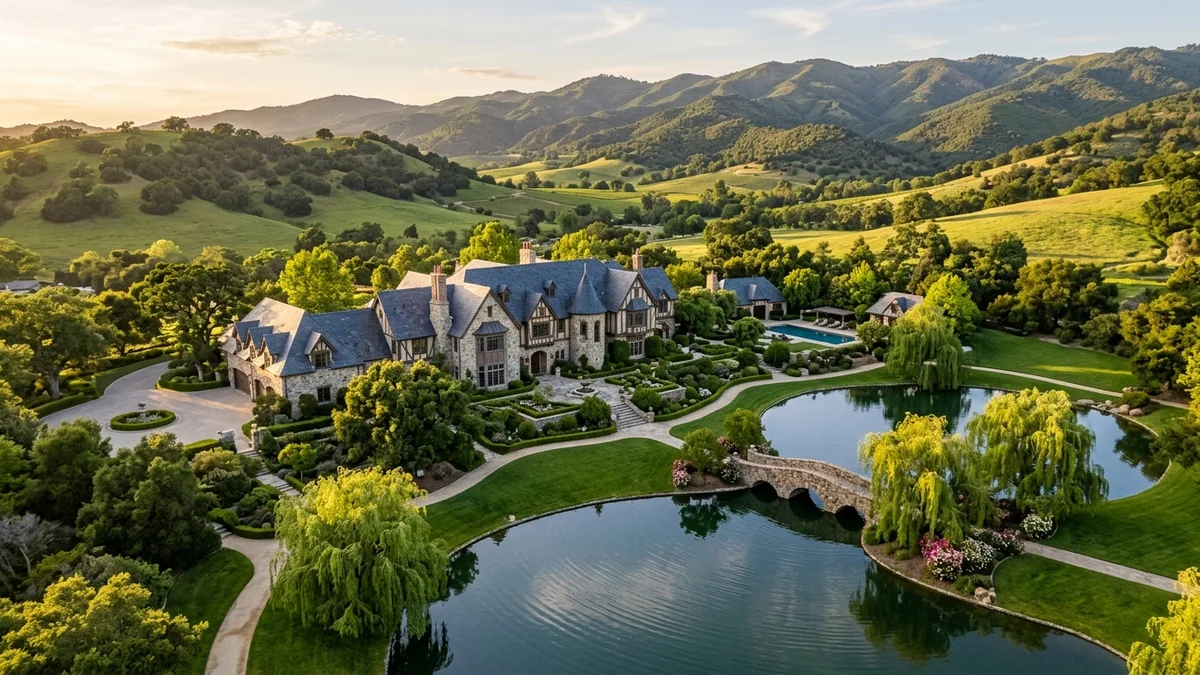
Few private properties in modern history have ignited as much intrigue, debate, and market curiosity as Neverland Valley Ranch. Nestled within California's picturesque Santa Ynez Valley, the 2,700-acre pastoral compound where Michael Jackson resided for over fifteen years became the center of an unprecedented real estate saga. Following years of physical neglect, asset liquidations, and an almost 80% price crash from its initial listing, this legendary trophy estate has undergone a meticulous restoration, reclaiming its authentic architectural stature.
"Neverland was not merely a trophy residence; it was the tangible realization of an imaginary realm executed on a territorial scale." — Cultural Heritage & Design Commentary.
The Origins as Sycamore Valley Ranch and Michael Jackson's Vision
Before becoming the King of Pop's fairytale retreat, the estate was known as Sycamore Valley Ranch. Designed and built in 1982 by renowned golf course developer William Bone, the property was originally conceived as a benchmark of pastoral luxury, enveloped by ancient coastal oaks, rolling meadows, and vineyard-ready hillsides.
Michael Jackson first visited the ranch in 1983 while filming the music video for Say Say Say alongside Paul McCartney. Drawn by the sheer vastness of the acreage and the absolute seclusion afforded by the surrounding mountain ranges, the artist acquired the estate in 1988 for an estimated sum between $19.5 million and $30 million. Renaming it after Peter Pan's mythical haven, Neverland transformed into an extraordinary marriage of European country estate architecture and private amusement park.
French Normandy Tudor Architecture and Private Leisure Grounds
At the core of the estate lies the primary residence, a 12,500-square-foot (~1,160 m²) mansion envisioned by architect Robert Altevers in the French Normandy Tudor Revival aesthetic. The manor features rustic stone facades, steep slate mansard rooflines, soaring exposed oak structural beams, and reclaimed 18th-century French oak parquet flooring throughout the reception rooms.
The interior layout comprises six primary suites, nine bathrooms, a custom paneled library, and an underground climate-controlled wine cellar. Outside, the home opens onto a serene 4-acre landscaped lake complete with swans, fountains, a stone arch bridge, and an expansive lagoon pool with a sand beach and natural stone waterfall.
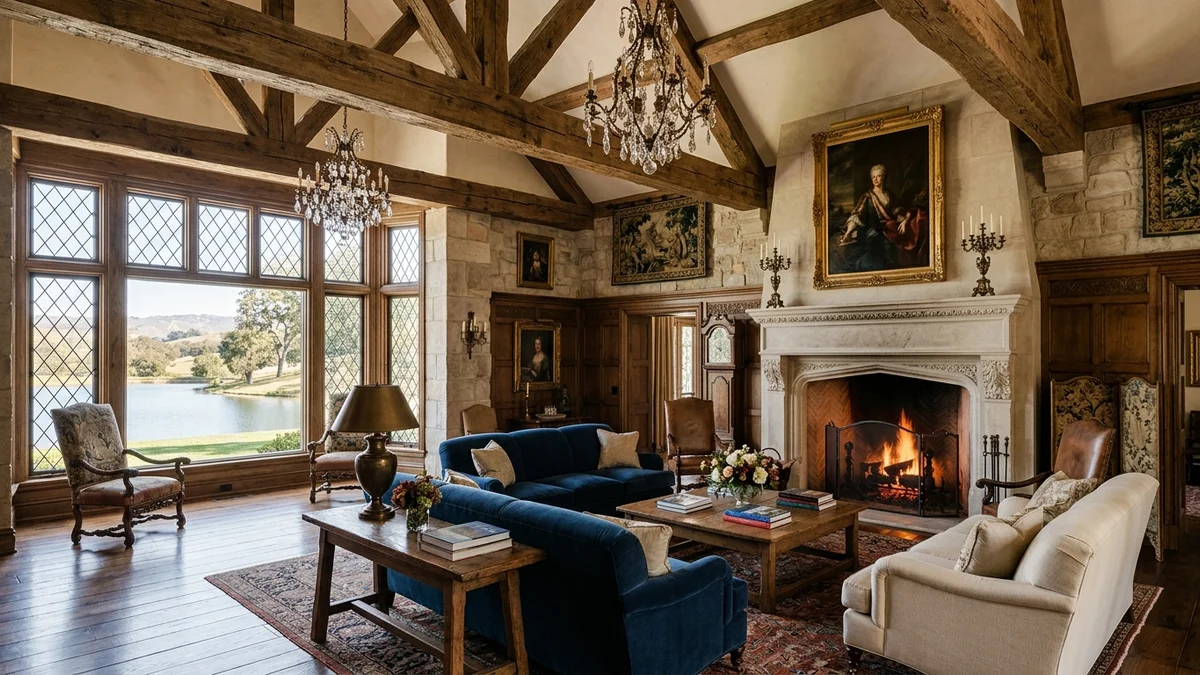
Grand living room: exposed timber trusses, monumental carved stone hearth, and panoramic picture windows overlooking the private lake.
Beyond the main residence, the compound functioned as a self-contained entertainment complex: a 50-seat private movie theater with velvet seating and live performance stage, a dance studio, two standalone guest houses, equestrian barns, an exotic animal zoo, and the famous narrow-gauge steam railroad (Crown 4-4-0), whose storybook Victorian depot featured an elaborate clock tower and a giant floral clock meticulously manicured with thousands of colorful flowers.
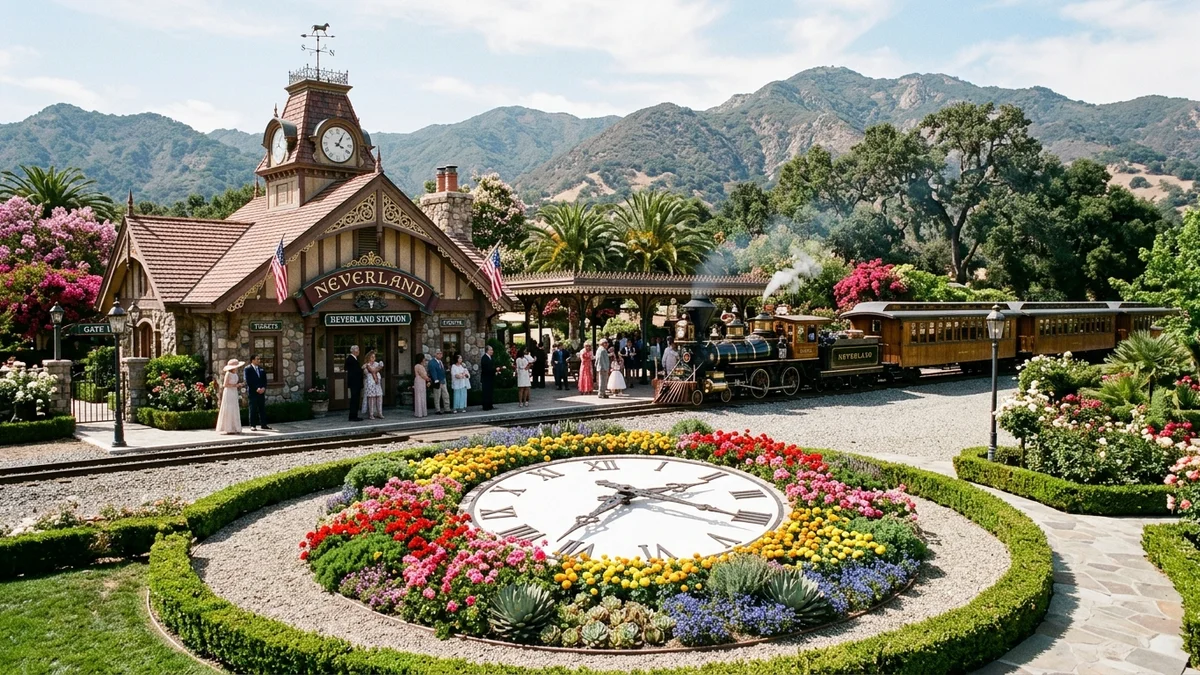
The Victorian-style train station and historic floral clock at Neverland, recently fully restored.
A Decade of Decay and Real Estate Market Challenges
Following the conclusion of his 2005 trial, Jackson publicly stated he would never return to live at Neverland, feeling that the intimacy of the sanctuary had been compromised. With his departure, the estate's heavy monthly maintenance overhead — exceeding $250,000 per month — proved unsustainable, leading to the gradual decommissioning and sale of the amusement park rides.
After Jackson's death in 2009, private investment firm Colony Capital, led by Tom Barrack, took over the property debt in partnership with the singer's estate. The property was rebranded under its original name, Sycamore Valley Ranch, and listed for sale in 2015 for an ambitious $100 million.
However, public notoriety, heavy upkeep requirements, and strict agricultural land-use restrictions in Santa Barbara County discouraged traditional ultra-luxury buyers. The price was repeatedly slashed: first to $67 million in 2017, then to $31 million in 2019, lingering on the market without finding a suitor.
The Acquisition by Ron Burkle and the Ranch's Restoration
In December 2020, billionaire Ron Burkle — co-founder of Yucaipa Companies and longtime confidant and financial adviser to Michael Jackson — purchased Neverland for approximately $22 million. The acquisition marked an almost 80% discount from the initial offering price, standing as one of the most remarkable land banking transactions in modern California history.
Under Burkle's ownership, comprehensive preservation efforts were launched. The private lake was dredged and restored, native riparian landscaping was reintroduced, the 50-seat theater received modern cinema technology, and the iconic train depot and floral clock were brought back to pristine condition. Today, the estate has regained its historic charm, serving as an authentic filming backdrop for the official biographical feature film celebrating Jackson's musical journey.
Architectural & Historical Matrix: Neverland Valley Ranch
| Parameter | Historical & Structural Data |
|---|---|
| Location | Santa Ynez Valley, Santa Barbara County, California |
| Total Acreage | 2,700 acres (~1,100 hectares) |
| Main House Area | 12,500 sq ft (~1,160 m²) — 6 bedrooms, 9 bathrooms |
| Architectural Style | French Normandy / Tudor Revival (Arch. Robert Altevers) |
| Listing Price History | $100M (2015) ➔ $67M (2017) ➔ $31M (2019) ➔ $22M (Sold in 2020) |
| Current Owner | Ron Burkle (Yucaipa Companies) |
Frequently Asked Questions
Who owns Neverland Ranch today and what did they pay for it?
American billionaire investor Ron Burkle, co-founder of Yucaipa Companies and former financial adviser to Michael Jackson, bought the estate in December 2020 for approximately $22 million — an almost 80% reduction from its original $100 million asking price.
How large is Neverland Ranch and where is it located?
The estate spans approximately 2,700 acres (~1,100 hectares) in the scenic Santa Ynez Valley of Santa Barbara County, California, surrounded by historic vineyards and scenic mountains.
Does the amusement park still exist at Neverland?
No. The amusement park rides, including the Ferris wheel, carousel, and roller coasters, were dismantled and auctioned off or sold after 2005. However, the Victorian train station and floral clock have been meticulously restored.
What architectural style is the main residence at Neverland?
The 12,500-square-foot (~1,160 m²) main house was designed by architect Robert Altevers in the French Normandy / Tudor Revival style, featuring rustic stonework, exposed timber ceiling beams, monumental fireplaces, and 18th-century French oak floors.
🏛️ Visualize Grand Estates with AI
Looking to design luxury estates, Tudor revival facades, or lakefront landscapes? The Arquitet IA app generates realistic 3D architectural transformations directly from photos of your property.
Try AI Architecture SimulatorThe Fate of Celebrity Trophy Real Estate
Neverland’s journey highlights a fundamental principle of ultra-prime real estate: estates customized for highly idiosyncratic personal tastes face substantial liquidity headwinds when returned to the open market. The ranch's recent restoration underscores that, once stripped of temporary excesses, the enduring architectural quality and scenic topography of the land remain its true, lasting asset.