Today, we glance into hallway mirrors and bathroom vanities without giving a second thought to the material value of the glass. Yet in 17th-century Europe, a single large sheet of crystal-clear Venetian mirror cost more than a sprawling productive vineyard or a fully armed 40-gun naval warship.
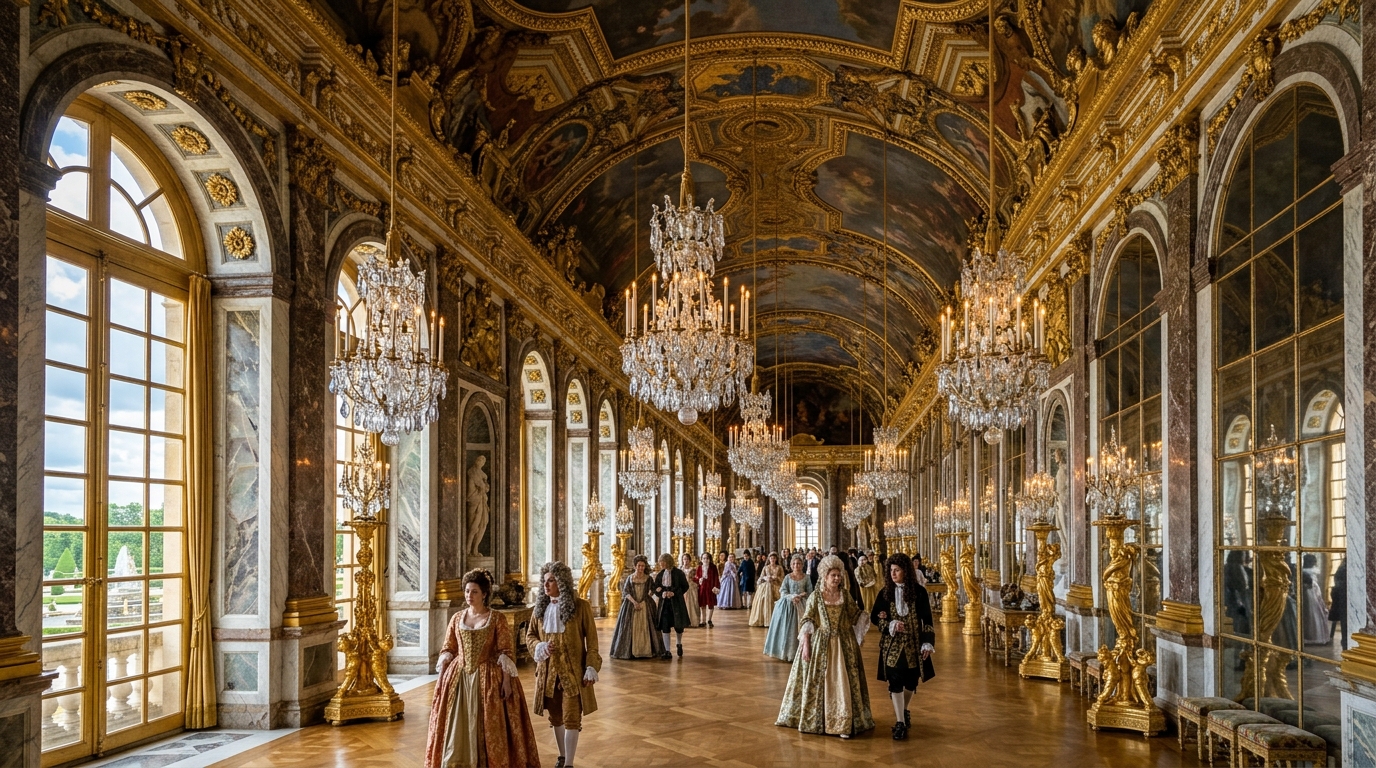
When King Louis XIV decided to build the legendary Hall of Mirrors (Galerie des Glaces) at the Palace of Versailles—incorporating 357 immense reflective panels—France was not merely undertaking a grand architectural project. It triggered a ruthless campaign of state-sponsored industrial espionage, high-stakes bribery, and fatal poisonings against the Republic of Venice.
The Murano Island Monopoly and Death Penalties
For over two centuries, the Venetian island of Murano maintained absolute control over the secret method of casting flawless transparent glass (*cristallo*) and backing it with an amalgam of molten tin and mercury. The distortion-free reflection was universally hailed as the pinnacle of European court luxury.
To safeguard their economic dominance, the Venetian Council of Ten issued severe decrees: any glassmaster attempting to flee the Venetian lagoon faced asset confiscation, imprisonment of their families, and immediate assassination by state agents.
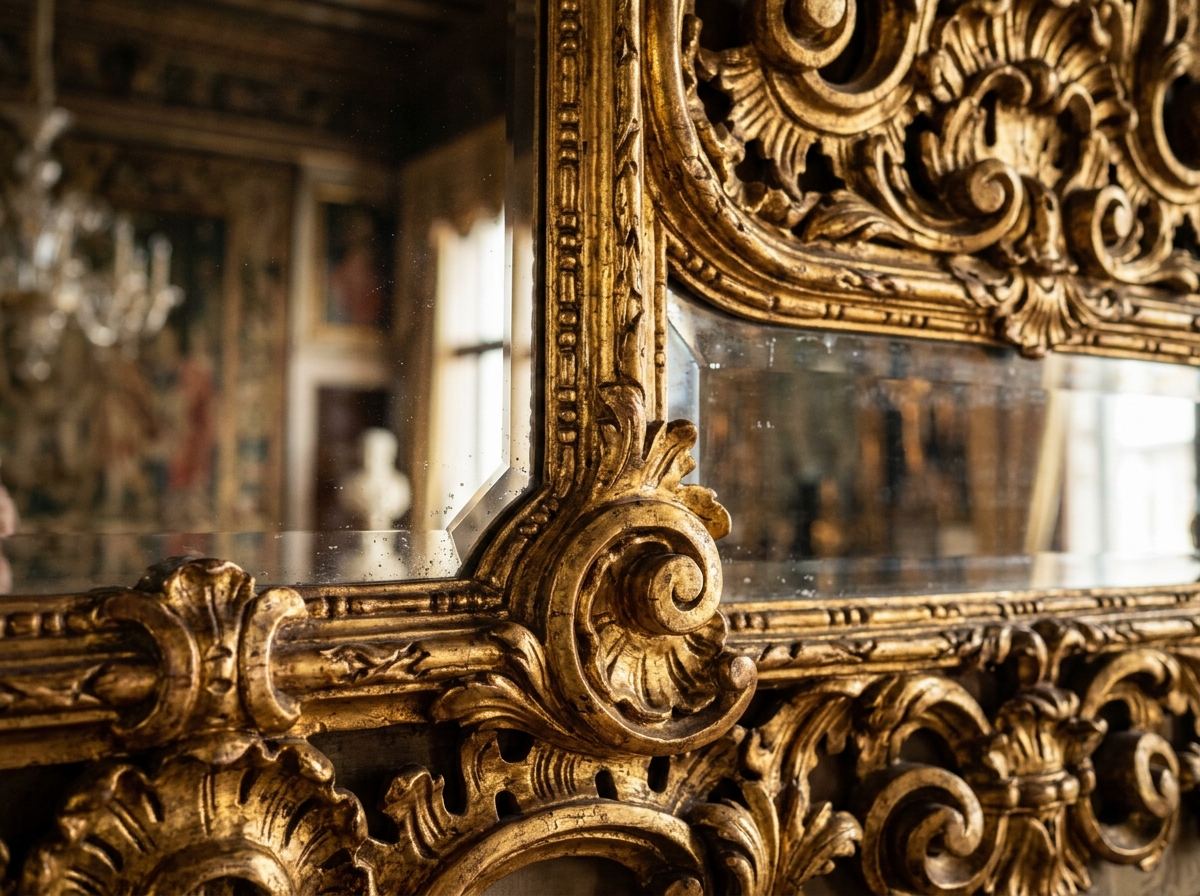
Venetian crystal from Murano: pristine optical clarity and mercury silvering that commanded royal fortunes.
Colbert's Covert Heist and Venice's Poisoned Retaliation
Determined to halt the massive outflow of French gold to Venice, Louis XIV's brilliant Minister of Finance, Jean-Baptiste Colbert, executed an audacious scheme in 1665. French diplomats bribed and smuggled four master Venetian glassmakers out of Murano and into a clandestine workshop in the Faubourg Saint-Antoine in Paris.
Venice responded decisively. Infiltrating spies into Paris, the Republic poisoned two of the key Venetian defectors with toxic doses of mercury and arsenic. Nevertheless, French apprentices had already mastered the chemical secrets, establishing the Royal Mirror Glass Manufactory—the historical foundation of modern manufacturing giant Saint-Gobain.
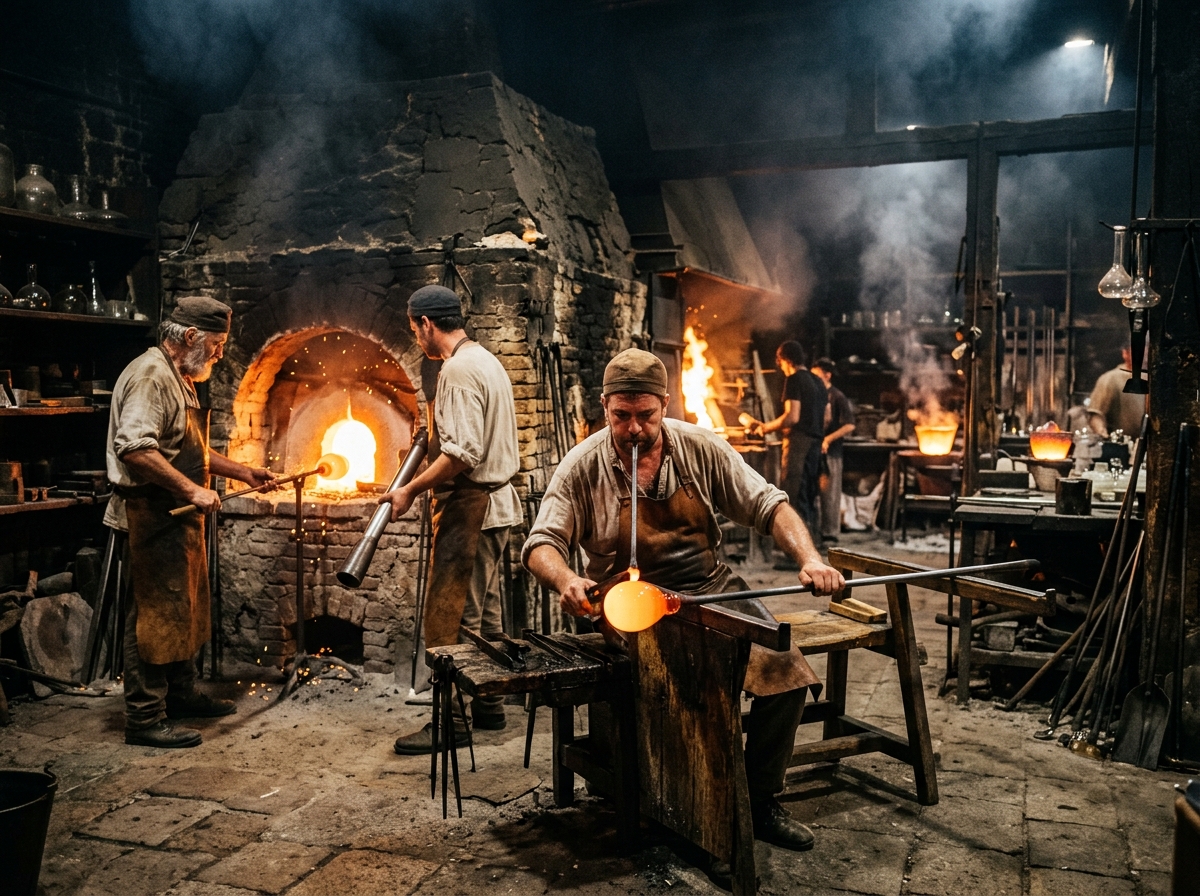
Murano's glassmaking furnaces: industrial secrets guarded as sovereign treasures in 17th-century Europe.
The Hall of Mirrors: Light Amplification and Optical Power
Inaugurated in 1684 under the direction of master architect Jules Hardouin-Mansart, the Hall of Mirrors spans 240 feet (73 meters) in length. Its 357 individual mirror panes were grouped into 17 sweeping arches positioned directly opposite 17 massive arched windows overlooking the manicured gardens of Versailles.
The architectural strategy was breathtaking: by day, the mirrors bounced the sky and gardens inward, creating the illusion that the palace walls had dissolved into nature. By night, thousands of candle flames multiplied endlessly across the glass surfaces, forging an unforgettable golden spectacle that stunned foreign ambassadors and projected the absolute dominance of the Sun King.
How Mirrors Expand Modern Architectural Spaces
The spatial principles perfected at Versailles remain foundational in modern interior architecture. Mirrors continue to be one of the most effective tools for multiplying natural sunlight, dissolving visual boundaries, and extending perceived room dimensions.
Whether installed as floor-to-ceiling panels in a dining room or hung as sculptural focal points above a credenza, proper orientation can make an interior feel twice its actual size. To explore broader aesthetic ideas, explore our guide to interior design styles and learn space-planning strategies in how to decorate a small living room with AI.
See how mirrors and lighting transform your home
Upload a photo of your hallway, living room, or bedroom and simulate mirror placements, glass partitions, and warm lighting in seconds on the Arquitet IA app.
Simulate Rooms in Arquitet IA →Frequently Asked Questions
Why were mirrors so expensive in the 17th century?
The formulation of flawless transparent crystal and tin-mercury backing was a fiercely guarded state secret in Venice. Production required months of perilous manual polishing, and many pieces cracked during cooling, making large mirrors extraordinary luxury assets.
How many mirrors make up the Hall of Mirrors at Versailles?
The gallery features 357 individual mirror panes arranged across 17 colossal arches, precisely mirroring 17 monumental windows overlooking the palace gardens.
Which modern global corporation originated from this Franco-Venetian rivalry?
The Manufacture Royale des Glaces de Miroirs, founded in 1665 by Finance Minister Colbert, eventually evolved into Saint-Gobain, one of the world's largest glass and building materials conglomerates today.
How can mirrors be used strategically in contemporary home design?
Position mirrors perpendicular to windows to double incoming natural daylight, mount floor-to-ceiling panels to expand narrow hallways and living rooms, or use large sculptural framed pieces as architectural centerpieces.